
AI voice agent: How to choose one that finishes work
Choose an AI voice agent that checks caller information, completes approved requests and hands exceptions to your team. Use this practical buyer's guide.
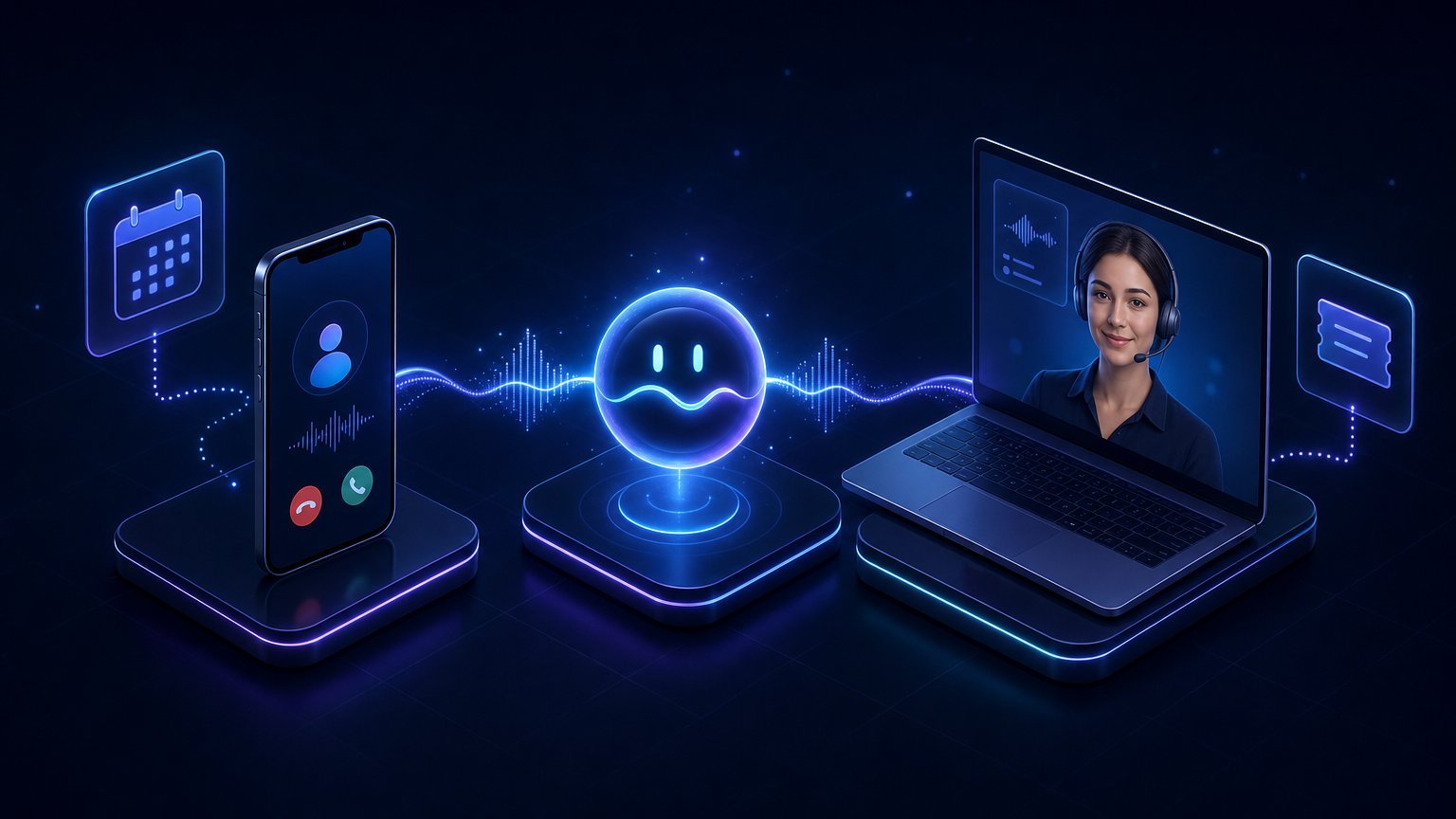
Quick Answer
An AI voice agent answers spoken requests and can use connected software to act on them. For business phone calls, choose one that can verify the caller, retrieve current information, complete an allowed request and pass exceptions to a person. Test those steps with realistic calls before judging the voice, price or demo.
When the front desk says “we miss calls when it gets busy,” the problem is not a lack of conversation. It is unfinished work: a booking never made, an order question left unanswered or another voicemail someone has to return.
An AI voice agent should help finish that work. A natural voice matters, but it is only one part of the buying decision.
This guide focuses on inbound customer calls. Outbound calling brings separate questions about consent, calling rules and campaign management.
What is an AI voice agent, and how does it work?
An AI voice agent is software that listens to spoken language, works out what the caller needs and responds by voice. When connected to business systems, it can also retrieve records and perform permitted actions.
A typical call follows this sequence:
- Listen. Speech recognition turns the caller's words into information the system can process.
- Understand. The agent identifies the request and asks for missing details.
- Check. It retrieves approved knowledge or current information from connected systems.
- Act. It carries out an allowed task, or asks a person to approve it.
- Confirm. It explains what happened and records the outcome.
The phrase conversational AI voice agent describes the same broad idea, with an emphasis on back-and-forth conversation rather than fixed menu choices.
Voice agents are not limited to phone lines. Some also work on a website, where a visitor talks to the agent face to face instead of typing into a chat window.
Not every product includes all five steps. Some answer general questions. Others collect a message. Others can change a booking or update a customer record. Ask which actions are actually included.
What should AI phone agents be able to finish?
AI phone agents should complete the routine requests you authorise, not merely promise that someone will call back. The right scope depends on your systems, policies and the consequences of a mistake.
Start with a table of real requests:
| Caller request | Information the agent needs | A completed outcome | When a person should take over |
|---|---|---|---|
| “Where is my order?” | Verified customer identity and current order status | Give the correct status and record the interaction | Missing order, conflicting records or a disputed delivery |
| “Can I change my appointment?” | Booking record, appointment rules and available slots | Make a permitted change and confirm it | Restricted appointment type or an exception to policy |
| “What does this service cost?” | Approved prices and eligibility rules | Explain the applicable price without inventing a quote | Custom pricing or unclear requirements |
| “I cannot access my account.” | Identity checks and an approved recovery process | Complete the authorised recovery steps | Failed verification or signs of account compromise |
| “I want a refund.” | Purchase record, refund policy and approval limits | Process an allowed request or submit it for approval | Disputed eligibility or a request above the limit |
These are evaluation scenarios, not features to assume every platform has.
For each request, distinguish read access from write access. Looking up an appointment is not the same as changing it. Reading a refund policy is not permission to issue a refund.
If you need broader reception coverage across channels, our AI receptionist software guide explains that buying decision.
How do you choose the best AI voice agent platform?
The best AI voice agent is the one that reliably completes your target workflow with acceptable effort, cost and risk. There is no useful universal winner without knowing what callers need and which systems hold the answers.
Compare the delivery approach before comparing individual voices.
| Approach | Best fit | What you need to check |
|---|---|---|
| Ready-made phone agent | Common requests with limited customisation | Whether it supports your exact systems and actions, not just FAQs |
| Voice agent within an existing contact centre | Teams keeping their current call operations | Which capabilities are included, which need extra work and how handoffs behave |
| Customised agent connected across systems | Requests that cross scheduling, CRM, order or support tools | Integration scope, permissions, testing and ongoing ownership |
| Developer platform or open source stack | Teams that want control and can maintain the system | Who owns telephony, speech services, security, monitoring and incidents |
Then ask vendors to demonstrate four things:
- Current information: Can it retrieve a live record rather than repeat a help article?
- Completed action: Does the requested change actually appear in the source system?
- Controlled exceptions: Does it stop when identity, policy or system access is uncertain?
- Useful handoff: Does the team receive the request, relevant context and what remains unresolved?
A product can sound excellent and still fail all four.
How should you test an AI voice agent before buying?
Test the agent against realistic calls and inspect the resulting records. A scripted conversation is not enough to establish whether the workflow works.
Use a test environment for actions that could affect customers.
1. Choose one recurring request
Pick something specific, such as checking an order or rescheduling an eligible appointment. Define what “finished” means before the demo starts.
“Answered the phone” is not a completion target.
2. Test caller verification
Ask for information about someone else's account. Try an incorrect reference number.
The agent should follow your identity rules and avoid revealing private information when verification fails.
3. Change the underlying information
Update a test record before the call, then ask about it. This checks whether the agent uses current system data rather than a prepared answer.
Ask what it does if the source system is unavailable.
4. Request an allowed action
Have it make a permitted change, then inspect the source system yourself. Check the details, confirmation and interaction record.
Also test a repeated request. A caller repeating themselves should not create a duplicate booking or transaction.
5. Ask for an exception
Request something outside the policy or above an approval limit. The correct outcome is a controlled handoff, not an improvised concession.
Test what happens when nobody is available. Does it explain the next step accurately, or promise an immediate response the team cannot provide?
6. Make the conversation difficult
Interrupt. Correct a date. Spell a name. Introduce background noise. Ask two questions together.
Listen for response delays, whether it stops speaking when interrupted and whether it confirms important details. These are practical usability checks, not cosmetic voice preferences.
7. Inspect what reaches the team
Review the handoff and logs. A person should be able to understand the request without making the caller start over.
Clarify whether “handoff” means a live phone transfer, a callback task, a ticket or an approval request. Those are different capabilities.
What should stay with a person?
People should keep decisions that involve sensitive judgment, policy exceptions or consequences beyond the agent's authority. Routine work can be automated without giving the agent unrestricted access.
Useful escalation triggers include:
- The caller asks for a person.
- Identity cannot be verified.
- Records disagree.
- The request exceeds an approval limit.
- The caller disputes a charge or policy.
- A required system is unavailable.
- The agent cannot establish what the caller means.
For an appointment business, this could mean allowing standard scheduling while leaving suitability decisions with qualified staff. For support, it could mean answering order questions while routing disputed refunds to the team.
Ask about call recordings and transcripts too: whether they are created, where they are stored, who can access them and when they are deleted. Recording consent and disclosure obligations depend on the call and jurisdiction.
Our guide to human oversight goes deeper into approvals and exception handling.
How much does an AI voice agent cost?
Compare the total cost of handling your call workload, not just the advertised subscription. Depending on the provider, charges can include usage, telephony, integrations, implementation and ongoing maintenance.
Ask each vendor to price the same scenario using your actual call volume and call lengths.
Check for:
- Platform or subscription fees.
- Per-minute or other usage charges.
- Phone numbers, carrier charges and transfers.
- Integration and setup work.
- Monitoring, support and changes.
- Recording and transcript storage.
- Minimum commitments and overages.
The cheapest AI voice agent is not necessarily the least expensive way to finish requests. A low-cost system that takes messages may leave most of the work with your team.
Measure the baseline first: which calls come in, how long staff spend on them and what follow-up each requires. Any savings estimate should come from that workload, not a vendor's unrelated example. Our AI automation ROI guide explains how to build that baseline.
How do Dapto's AI voice agents work on the website and the phone?
Our voice agent is one agent working in two places. On your website, visitors tap Talk in the chat and speak with a lifelike agent on screen, seeing its face and hearing its voice as they would with a person. On your phone line, you forward your number and the same agent picks up calls by voice, day or night.
Wherever the conversation happens, it listens, replies out loud using what your Brand Core says, and gets the request done while the conversation continues. It speaks in short, natural sentences rather than menus. When it needs a moment to look something up, it tells the caller, so nobody sits in silence. If someone cuts in, it stops talking and listens. You choose who answers: Amara for support, Daniel for sales, Nia as an advisor or Marco as a specialist. Each call is written up as a transcript in Conversations, alongside your chats.
Voice is one channel of our Customer Service Agents. A caller gets the same answer they would get in website chat, email or WhatsApp, because every channel works from one Brand Core and the same Playbooks. Change a policy once and every channel follows.
It handles both sides of your customer base:
- New customers: it asks for whatever is missing, books the meeting into your calendar during the call and gives the lead a score out of 100 with the reasons, saved to your CRM.
- Existing customers: it pulls up their account, order or booking and finishes what they ask within your limits, such as checking an order, moving a booking or updating a record.
You describe how each job gets done in a Playbook, in plain words, the way you would brief someone new. When a request needs approval or a human touch, the agent explains the next step to the caller and notifies the teammate who should handle it, passing along a short summary plus everything said so far, so nobody asks the caller to start again. Anything that needs follow-up lands in the built-in, AI-native Helpdesk with priority, queue and SLA already set, along with an AI summary and a suggested reply.
Answers are tested in the Playground before anything goes live, and we never use customer data to train AI models. You can try our Customer Service Agents yourself free for 7 days. They go live the same day and you do not need a developer.
How does Dapto connect a voice agent to your systems?
We start with the request that needs finishing and the systems holding the information. We customise prebuilt Customer Service Agents around that work rather than asking you to replace your CRM or help desk.
Our Brand Core gives agents a shared reference for your services, prices, policies and tone. Connected systems supply the information needed for a particular request.
Within agreed permissions, an agent can retrieve information, resolve a request and update the CRM. Actions above an agreed limit go to a person for approval. Your team keeps the exceptions and sensitive decisions.
We restrict what agents can access, log and monitor their actions, evaluate outputs before they go out and require approval for sensitive steps. Our security and trust guide explains our security posture.
For workflows covered by our prebuilt agents, the starting point is customisation. An audit is not required first. Work outside that scope starts with an AI Opportunity Audit to establish what should be built.
A useful first conversation is about one recurring call: what the caller asks, where the answer lives, what action follows and when your team must decide. We then look at the volume and time spent on that work with you.
FAQ
Which is the best AI voice agent?
The best AI voice agent depends on the requests you need handled and the systems it must use. Compare options with the same test calls, including an allowed action, failed verification and a policy exception. Choose based on completed work, reliable handoffs and total operating cost.
Can the same AI voice agent answer my phone and talk to visitors on my website?
With some platforms, yes. Dapto's voice agent works in both places: website visitors tap Talk for a face to face conversation, and the same agent answers your forwarded phone line by voice, day or night. Both use the same business knowledge and Playbooks, and every call is transcribed next to your chats.
Can I use ChatGPT as a voice assistant?
ChatGPT supports voice conversations, but a voice conversation is not the same as a business phone workflow. Handling customer calls also requires telephony, authorised system access, identity checks, action permissions and escalation. Evaluate the complete implementation rather than the conversational model alone.
Can you do an AI voice?
Yes. AI speech systems can generate spoken responses from text, and conversational systems can combine that with speech recognition. A generated voice alone does not retrieve customer information or complete business requests.
How do you create an AI voice agent?
Start by defining one call type, its required information, allowed actions and escalation rules. Then connect telephony, speech processing, approved knowledge and the relevant business systems. Test normal calls and failures before expanding access or call volume.
Is an AI voice agent suitable for a small business?
An AI voice agent can suit a small business when recurring calls interrupt work or wait unanswered. Begin with a narrow request that has clear rules, such as service questions or standard booking requests. Check that someone owns exceptions and that the agent works with the systems already in use.
Should I choose an open source AI voice agent?
Open source can suit a team that wants control and has the skills to operate the complete system. It does not remove the work of connecting phone services, securing data, evaluating calls or maintaining integrations. Compare total ownership effort with a managed option.
Can AI voice agents be used in healthcare?
Potential uses include administrative requests such as opening hours and appointment coordination, subject to appropriate privacy and security controls. Clinical advice and urgent symptoms need clearly defined routes to qualified people. Verify applicable obligations, contracts and safeguards rather than treating a general security claim as proof of healthcare suitability.
See how this applies in practice with Dapto Workbench - an AI work platform for reports, documents, data checks, and other repeatable business work.
Learn more