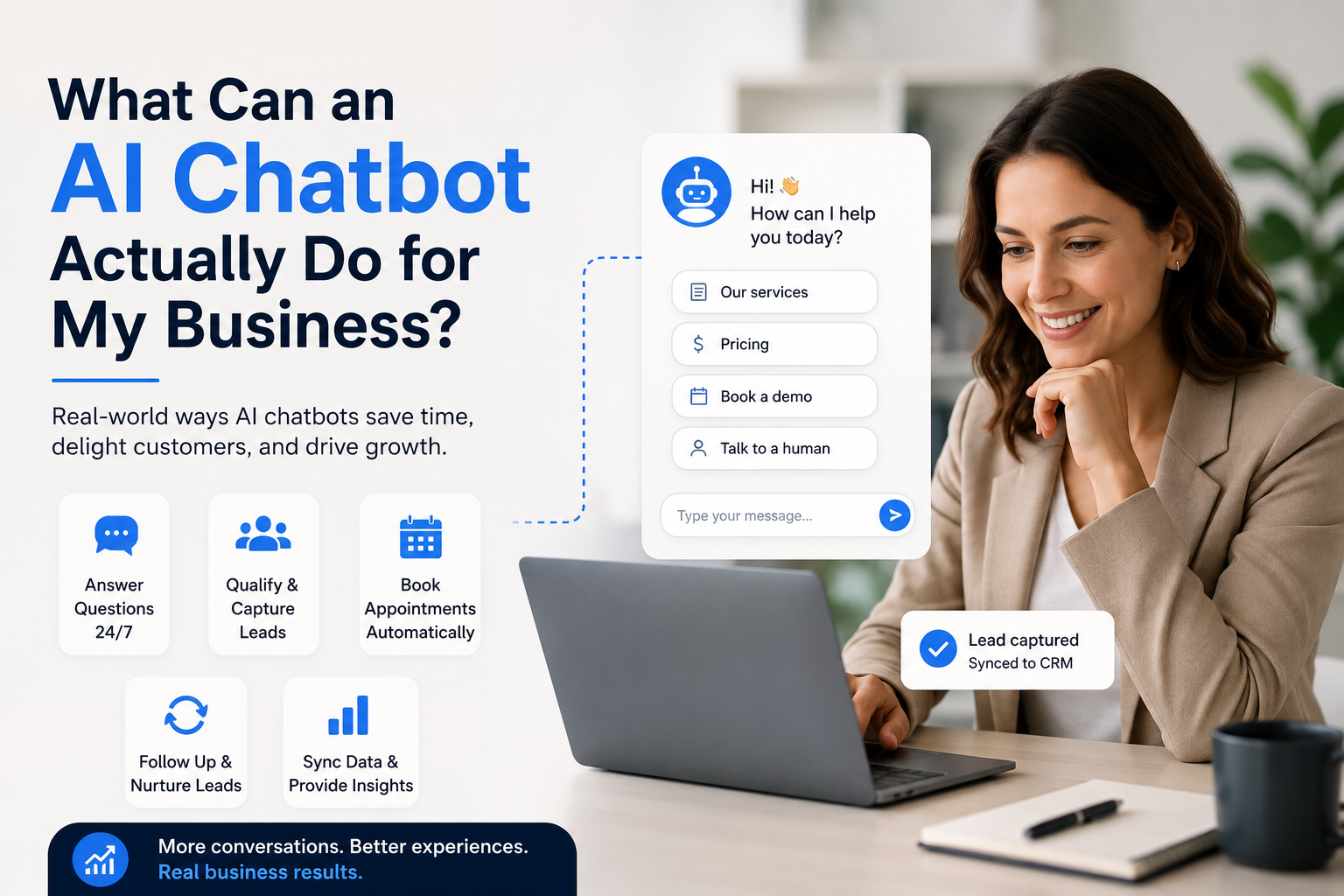
What Can an AI Chatbot Actually Do for My Business?
A straight answer on what AI chatbots really do in 2026 — the tasks they handle, the percentage of inquiries they resolve, what they still can't do, and how to tell a real AI front office from a glorified FAQ widget.
Quick Answer
An AI chatbot can answer questions about your business using your own content, qualify inbound leads, book appointments on your calendar, follow up by email and SMS, and hand off to a human with full context. In practice, a well-configured agent resolves roughly 40–70% of routine inquiries without human involvement.
Most business owners asking this question have already met a bad chatbot — the one on a competitor's site that answered three questions with the same paragraph and then offered a contact form.
That experience is real, and it's why the honest answer to "what can an AI chatbot do for my business" starts with a distinction almost nobody selling one will make: "chatbot" describes at least three different products, and the gap between them is the difference between a novelty and a revenue line.
What is an AI chatbot, actually?
An AI chatbot is software that holds a conversation with a visitor and completes a task. The word covers three generations of technology that behave nothing alike, and buying the wrong tier is the single most common reason businesses conclude "AI chatbots don't work."
| Tier | What it is | What it can do | What it can't do |
|---|---|---|---|
| 1. Scripted bot | Decision-tree menus and keyword rules | Route to a page, collect a form field, answer 5–10 canned questions | Handle any phrasing you didn't anticipate |
| 2. Knowledge-grounded bot (RAG) | Reads your site, docs, and FAQs; answers in natural language | Answer open-ended questions accurately from your content | Take action — no booking, no CRM writes, no follow-up |
| 3. AI agent | Grounded answers plus the ability to act in your systems | Qualify, book, escalate, update records, follow up across channels | Judgment calls, negotiation, anything requiring a licensed human |
Tier 1 is what soured everyone. Tier 2 is what most "AI chatbot" tools on a $49/month plan actually ship. Tier 3 is what people picture when they imagine an AI employee — and it's the only tier that changes a P&L.
Everything below describes Tier 3.
What can an AI chatbot actually do for my business?
A Tier 3 AI agent handles the repeatable front-office work that arrives through your website, and it does it in seconds, at 2 a.m., on a holiday weekend. Concretely:
Answer questions from your own material. Pricing structure, service area, licensing, turnaround time, what happens at a first consultation, whether you handle a specific case type. The agent is grounded in your knowledge base — your pages, PDFs, intake docs, past answers — not the open internet.
Qualify a lead against your criteria. Not "name and email." Budget range, timeline, jurisdiction, case type, property type, headcount — whatever separates a real opportunity from a tire-kicker in your business. It asks in conversation, not in a nine-field form that 60% of visitors abandon.
Book directly onto a calendar. Real availability, real time zone, real confirmation, real calendar invite. This is the capability line most tools quietly fail to cross.
Follow up across channels. Someone starts a chat at 11 p.m. and drops off before booking. The agent emails and texts a sequence over the next several days. This is where a large share of recovered revenue actually comes from — not the initial conversation.
Escalate with full context. When it hits a question it shouldn't answer, it hands off — with the transcript, the qualification data, and a clear reason. Your team picks up mid-conversation instead of starting cold.
Write to your systems. New lead in the CRM, tagged and scored, with the transcript attached. No re-keying.
Handle volume spikes without hiring. A campaign, a local news mention, a seasonal rush — the response time is the same at 5 inquiries a day and 200.
Answer in the visitor's language. Useful in immigration, healthcare, hospitality, and any service business with a multilingual customer base.
How much of my inbound can an AI chatbot really handle?
Plan on 40–70% of routine conversations being fully resolved without a human. Anything a vendor claims above that is either a narrow use case or a different metric.
Two things to understand before you evaluate anyone's numbers:
Resolution is not deflection. Deflection counts conversations a human never touched. Resolution counts problems actually solved. They get conflated constantly in marketing, and the gap between them is where disappointed buyers live.
Vendor benchmarks compress in production. Intercom, the most-benchmarked player in the category, publishes an average resolution rate around 67% across its customer base. Independent 2026 reviews consistently land lower in the field — Intercom's own published case studies cluster in the 42–50% range, and one small-business test of 500 real tickets came in at 38%. B2B and regulated verticals run meaningfully below general benchmarks because the questions are harder.
None of that means the technology is oversold. It means the honest planning number is 40–70%, and the biggest lever on where you land inside that range isn't the vendor's model — it's the quality of your knowledge base and whether the agent is allowed to take actions rather than just retrieve answers. An agent that can look something up and book something resolves far more than one that can only talk.
What's the actual business case?
The case rarely rests on headcount savings for a small business. It rests on speed to lead — and the research on that is old, specific, and brutal.
The foundational study, run by Dr. James Oldroyd and published through MIT/InsideSales, found that contacting a web lead within five minutes rather than thirty made a business roughly 100x more likely to make contact and 21x more likely to qualify that lead.
The follow-on Harvard Business Review article, The Short Life of Online Sales Leads (Oldroyd, McElheran, and Elkington, March 2011), audited 2,241 U.S. companies on how fast they responded to a test inquiry. The findings:
- Average response time among companies that responded at all: 42 hours
- Companies that never responded: 23%
- Responding within an hour vs. an hour later: ~7x more likely to qualify the lead
- Responding within an hour vs. 24+ hours later: ~60x more likely to qualify
Two caveats worth stating plainly, because most blog posts citing these numbers don't: the multipliers are relative, not absolute — 21x on a 0.1% baseline is still 2.1% — and the underlying data predates the smartphone era. Later studies have consistently pointed the same direction, but treat the direction as the finding, not the decimal places.
Here's why it still matters more now than it did in 2011: your prospect submitted the same inquiry to three of your competitors in the same browsing session. The 42-hour average isn't a benchmark to beat by a few hours. It's a market where responding in under a minute is a structural advantage that almost nobody holds.
The rough math for a service business:
| Input | Example |
|---|---|
| Monthly website inquiries | 60 |
| Currently reached within 5 minutes | ~10 |
| Average closed-deal value | $3,500 |
| Close rate on fast-response leads | 20% |
| Close rate on slow-response leads | 6% |
Moving the other 50 inquiries from slow to fast response at those rates is roughly $24,500/month in additional pipeline value. Cut it in half for optimism and it still clears the cost of every tool in this category by an order of magnitude.
Run that table with your own numbers before you talk to any vendor. If it doesn't clear, don't buy — and be suspicious of anyone unwilling to do the exercise with you.
What can't an AI chatbot do?
This is the section most vendor content skips, which is exactly why it belongs here.
- Give legal, medical, or financial advice. It can explain your process, your fees, and your intake requirements. It should refuse to opine on someone's specific situation, and you should verify that it refuses.
- Make judgment calls on exceptions. Discounts, edge-case eligibility, angry-customer recovery. These escalate.
- Fix a broken offer. If your pricing is uncompetitive or your service area is wrong, faster responses just get you to "no" faster.
- Work from a bad knowledge base. Grounding quality is the ceiling on answer quality. A chatbot fed a thin, outdated website will produce thin, outdated answers — and knowledge drift is a documented top-three failure mode across the category.
- Run itself forever. Content changes, offers change, questions change. Something has to own the maintenance. Either you do it or your vendor does — but if nobody does, performance decays quietly over months.
- Replace human relationship-building on high-consideration, high-ticket sales. It gets the qualified prospect to a booked meeting. The meeting is still yours.
Which businesses get the most out of one?
The value scales with three things: inquiry volume, deal value, and how much of your inbound arrives outside business hours.
Strongest fit:
- Professional services — law firms, accounting practices, agencies, consultancies. High deal value, heavy question load, slow incumbent response times.
- Appointment-driven local businesses — med spas, clinics, dental, home services, salons. Booking is the conversion event.
- Considered-purchase venues and vendors — wedding and event venues, caterers, design-build remodelers. Long question lists, long buying cycles, high value per booking.
- Any business running paid traffic. You're already paying for the click. Losing the lead to a 42-hour response window is the most expensive line item you're not measuring.
Weakest fit: transactional low-ticket ecommerce with a mature help center, and businesses whose inbound is almost entirely phone-based referrals.
How do I know if it's actually working?
Demand these four numbers from day one. If a vendor can't report them, that tells you what you need to know.
- Resolution rate — conversations fully handled, not conversations a human didn't see. Insist on the definition in writing.
- Lead disposition — every inquiry accounted for: qualified, disqualified, escalated, no-response. Unaccounted conversations are where leads die.
- Time to first response and time to escalation — sub-60 seconds for both is the working target.
- Booked appointments attributed to the agent — the only metric that maps directly to revenue.
Watch the trap: many tools report "conversations handled" and let you infer success. That's a vanity metric. And be careful with any vendor that bills per resolution while also defining what counts as one — an "assumed resolution" rule where 24 hours of customer silence counts as a win is standard in the category and it inflates the number in the vendor's favor.
How do I get started without wasting three months?
Weeks 1–2 — Scope one job. Pick a single outcome: booked consultations, or qualified inquiries routed to sales. Not "handle customer service." One job, one metric.
Weeks 2–3 — Fix the knowledge base first. Write down the 30 questions you actually get. Answer them properly. This is the highest-leverage two days of work in the whole project and it's the step everyone skips.
Week 3 — Set escalation rules before launch. What must always reach a human? Write it down. Test that the agent refuses those questions.
Week 4 — Launch on live traffic and read transcripts. Not a sample. All of them, for the first two weeks. Every bad answer is a gap in your knowledge base, and you'll fix 80% of the failure modes in the first ten transcripts.
Weeks 5–8 — Measure against a real baseline. You need the "before" number. If you never measured your current response time, measure it this week — submit a form on your own site and start a stopwatch.
The Dapto view
We built Dapto Frontdesk around the part of this that most tools leave to the buyer: accountability for the outcome, not access to a tool.
That means grounded answers only — the agent refuses rather than improvises when it's outside your knowledge base. It means every inquiry gets an explicit disposition, so nothing quietly disappears. It means we configure, tune, and maintain the knowledge base rather than shipping you a dashboard and a login. And it means flat pricing — $299/month plus a one-time $499 setup — so your bill doesn't rise as a punishment for the agent working well.
If you want to see what it does with your website's content rather than a canned demo, submit your URL and we'll send back a live demo agent trained on your own pages.
Frequently asked questions
What can an AI chatbot do for a small business?
It answers customer questions from your own content, qualifies leads against your criteria, books appointments on your calendar, follows up by email and SMS, and escalates to your team with full context — 24/7, in seconds.
What's the difference between an AI chatbot and an AI agent?
A chatbot answers questions. An AI agent answers and takes action — booking appointments, updating your CRM, sending follow-ups. The ability to act is what separates a support widget from a front-office worker.
How accurate are AI chatbots?
Accuracy depends almost entirely on grounding. An agent restricted to your verified content and configured to refuse rather than guess is highly reliable on in-scope questions. One trained on scraped, outdated pages is not. Ask any vendor what happens when the agent doesn't know.
Will an AI chatbot replace my receptionist or sales rep?
No. It removes the repetitive front-office load — after-hours inquiries, first-response, qualification, scheduling — so your people spend their time on conversations that need a human. Most small businesses use it to avoid a hire, not to make one redundant.
How much does an AI chatbot cost?
Self-serve tools start around $50–$100/month but require you to build and maintain everything. Managed AI front-office services typically run $200–$500/month plus setup. Usage-based vendors bill per resolved conversation, which means your cost rises as volume rises.
How long does it take to set up an AI chatbot?
A basic FAQ bot deploys in an afternoon. A properly grounded agent that books appointments and integrates with your CRM takes two to four weeks, and most of that is organizing your knowledge base, not technical work.
Can an AI chatbot book appointments?
Yes — a Tier 3 agent connects to your calendar, checks real availability, handles time zones, and sends confirmations. Many tools marketed as "AI chatbots" cannot do this. Confirm it explicitly before buying.
See how this applies in practice with Dapto Frontdesk - an AI website assistant that answers questions, qualifies leads, and books meetings on fixed, predictable pricing.
Learn more