
What Are AI Agents? How They Work, Why They Matter, and What's Changing in 2026
AI agents are autonomous software that plans, executes, and delivers finished work without step-by-step human input. Learn how they work, where they're used, and what's changing in 2026.
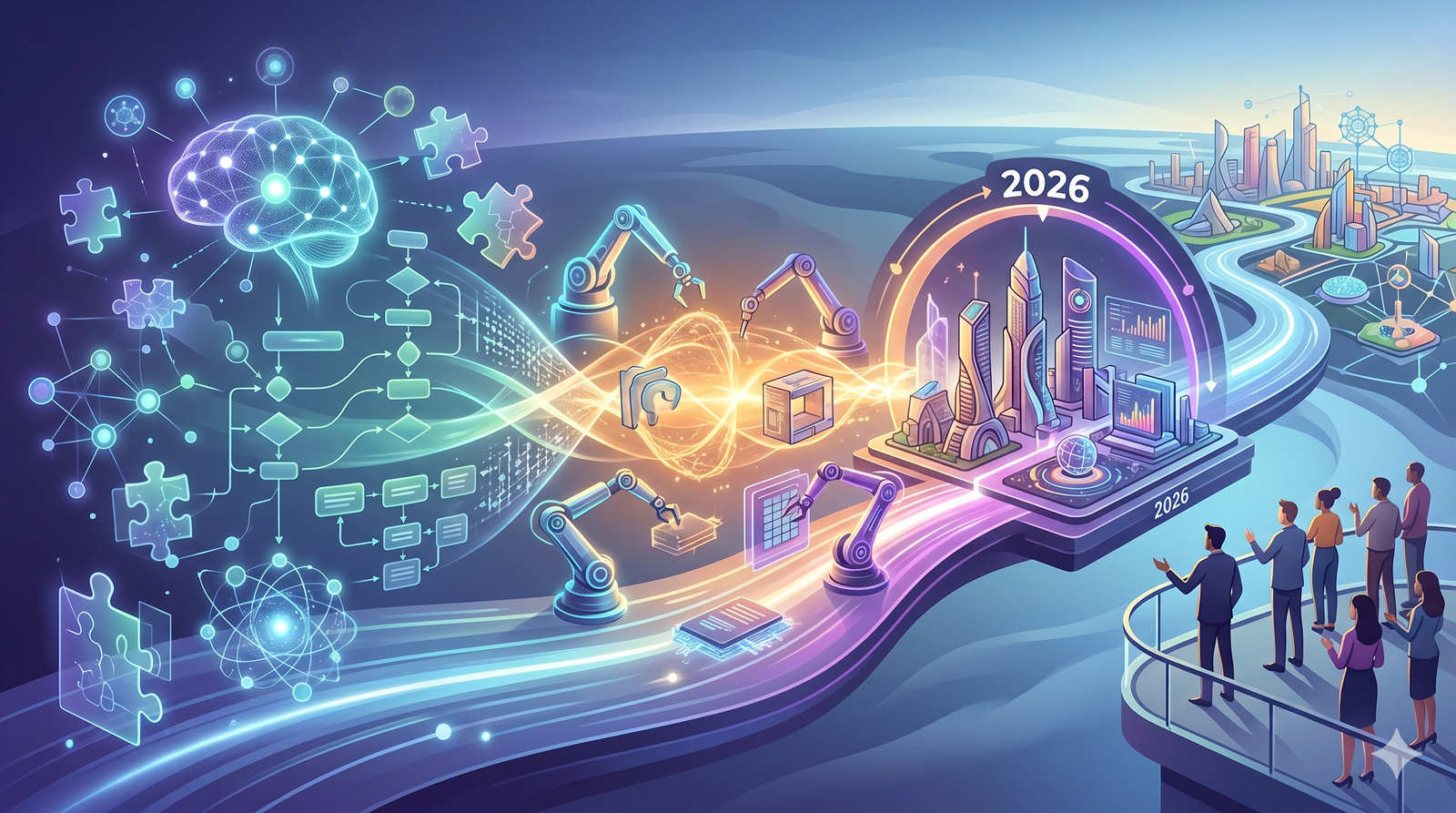
You ask ChatGPT to analyze 50 competitors. It gives you a nice paragraph about the first ten. By number thirty, it starts making things up. By fifty, you're doing the work yourself.
That is the limit of traditional AI tools. They respond. They don't execute.
AI agents are different. You give them a goal. They figure out the steps. They do the work. And they hand you the finished result.
This isn't a future prediction. Over half of all enterprises already have AI agents running in production today. The global AI agent market hit $10.9 billion in 2026 and is on pace to cross $50 billion by 2030.
If you lead a team, run a business, or make technology decisions, you need to understand what AI agents are, how they actually work, and what they can and can't do right now. This guide covers all of it.
What Is an AI Agent?
An AI agent is software that can take a goal, break it into steps, use tools to complete each step, and deliver a finished result — all without you managing every action along the way.
That last part matters. Traditional AI waits for your next prompt. An AI agent keeps going until the job is done.
Here's a simple example. Say you need a market research report on electric vehicle startups in Europe. With a chatbot, you'd prompt it, copy the output, prompt again for more detail, copy again, format it in a doc, check the numbers, and fix the errors. That takes hours.
With an AI agent, you describe what you want once. The agent searches the web, reads company filings, pulls financial data, organizes everything into a structured report, and hands you a finished document. You review the output instead of building it from scratch.
The core idea is simple: AI agents do work, not just conversation.
How AI Went From Chatbots to Copilots to Agents
To understand where AI agents fit, it helps to see how we got here. The evolution happened in three clear stages.
Stage 1: Chatbots (2022–2023)
ChatGPT launched in late 2022 and changed everything overnight. Suddenly, anyone could have a conversation with AI. You asked a question. It answered.
But chatbots had serious limits. They had no memory between sessions. They couldn't access the internet. They couldn't use tools or create files. Every interaction was a one-off conversation. You still did all the real work.
Stage 2: Copilots (2024–2025)
The next wave added tools to AI. Microsoft Copilot could read your emails and summarize meetings. GitHub Copilot could autocomplete code. These AI copilots worked alongside you inside existing software.
Copilots were helpful. But they still needed you at every step. You told the copilot what to do. It helped you do it. You were still the one assembling the final product.
Think of copilots like a smart assistant sitting next to you. They hand you tools when you ask. But you're still the one building the house.
Stage 3: Autonomous Agents (2025–Present)
AI agents took the next logical step. Instead of assisting you with individual tasks, agents handle the entire workflow from start to finish.
You say "build me a competitive analysis of five CRM platforms." The agent decides which sources to check. It reads product pages, reviews, and pricing data. It structures the comparison. It produces a finished deliverable you can share with your team.
The shift from copilot to agent is the shift from "AI helps me work" to "AI does the work."
This is where the industry is right now. According to McKinsey's 2025 State of AI report, 88% of organizations use AI in at least one business function. But only 6% have achieved high-performer status — meaning they actually get measurable business results from AI. The gap between "using AI" and "getting real value from AI" is exactly where agents come in.
How AI Agents Actually Work
AI agents look like magic from the outside. But under the hood, they follow a clear process. Every agent has five core parts.
1. Perception: Taking In Information
The agent receives your request and gathers context. This includes your instructions, any files you attach, data it can access from connected tools, and information it finds on the web. The better the input, the better the output.
2. Planning: Breaking Down the Goal
This is what separates agents from chatbots. The agent takes your goal and breaks it into a sequence of smaller tasks. If you ask for a competitive analysis, the agent might plan steps like: identify the companies, research each one individually, compare features, compare pricing, compile the results, and format the output.
The planning step is where the AI "thinks before it acts." More advanced agents can adjust their plan mid-execution if they hit a roadblock or find new information.
3. Tool Use: Doing the Work
Agents don't just generate text. They use tools. Depending on the platform, an agent might browse the web, read documents, run code, query databases, create spreadsheets, generate charts, or build applications.
Tool use is the key difference between "AI that talks" and "AI that works." A chatbot can describe how to build a dashboard. An agent builds the dashboard.
4. Execution: Running the Tasks
The agent works through its plan step by step. It completes one task, checks the result, and moves to the next. If something fails — a website doesn't load, data is missing, a tool returns an error — a well-built agent can adjust and try a different approach.
This happens without you sitting there prompting it. You can close your browser and come back when it's done.
5. Output: Delivering the Result
The final step is assembling everything into a finished deliverable. Depending on the task, this might be a research report, a presentation, a working web application, a data analysis with charts, or a structured spreadsheet.
The result is something you can use right away — not a draft you have to spend two hours cleaning up.
Single Agents vs. Multi-Agent Systems
Early AI agents worked as a single model handling everything. One AI did the planning, the research, the analysis, and the writing. This works for simple tasks. But for complex jobs, a single agent hits the same limits as a single person trying to do everything alone.
That's why multi-agent systems exist.
In a multi-agent setup, a coordinator agent receives your goal and delegates subtasks to specialized agents. One agent might handle web research. Another processes data. Another writes the report. Another checks for errors. They work in parallel and combine their results.
Think of it like a project team. The coordinator is the project manager. Each specialist agent handles what they're best at. The project manager assembles the final output.
This architecture solves a real problem. If you ask a single AI model to analyze 100 companies, quality drops after the first few. The model's attention degrades. It starts cutting corners, shortening descriptions, and eventually fabricating data to fill gaps. This is a known limitation of how large language models handle long contexts.
Multi-agent systems fix this by assigning each company to an independent agent. Agent number 50 gets the same fresh context and full attention as agent number 1. Quality stays consistent across all 100 analyses.
Anthropic's engineering team confirmed this approach works. Their internal evaluations showed that multi-agent research systems significantly outperform single-agent setups, especially for tasks that involve pursuing multiple independent directions at the same time.
Where AI Agents Are Being Used Today
AI agents are no longer experimental. According to industry data, 51% of enterprises already have AI agents running in production, with another 23% actively scaling them. Here are the areas seeing the most adoption.
Research and Analysis
This is the most common use case right now. Research and summarization accounts for roughly 25% of the AI agent market. Agents can search the web, read documents, analyze data, and produce structured reports — all tasks that used to take a knowledge worker hours or days.
Software Development
Coding agents like Devin and Claude Code can write, test, debug, and deploy software autonomously. Engineering teams use them to automate development pipelines, handle code reviews, and accelerate feature delivery.
Sales and Marketing
AI agents now handle lead research, outreach personalization, CRM updates, and pipeline management. Some sales agents operate fully autonomously — researching prospects, writing personalized emails, and booking meetings without human involvement.
Customer Service
AI agents resolve customer support tickets end-to-end. They can verify identity, look up account history, apply resolutions, and send confirmations. Gartner predicts that by 2029, AI agents will resolve 80% of common customer service issues without human involvement.
Content and Document Production
Agents can produce finished documents: reports, presentations, spreadsheets, and even full web applications. The output goes beyond text generation — these are formatted, structured deliverables ready for business use.
What AI Agents Can't Do (Yet)
The hype around AI agents is real, but so are the limits. Being honest about what agents can't do is just as important as understanding what they can.
They struggle with truly novel problems.
Agents excel at well-defined tasks with clear steps. Ask one to "analyze our Q3 revenue data" and it performs well. Ask it to "develop a new market strategy for a product that doesn't exist yet" and the output will be generic. Original strategic thinking still requires human judgment.
They can make confident mistakes.
AI agents use large language models, which means they can hallucinate — stating something incorrect with complete confidence. This risk increases on tasks that require precise factual accuracy, like legal analysis or medical recommendations. Always verify outputs on high-stakes decisions.
They don't replace judgment.
Agents execute tasks. They don't understand your business context, your team dynamics, or the political landscape of your organization. They can give you a competitive analysis, but deciding what to do with that analysis is still your job.
Reliability varies.
Not all agent platforms deliver consistent results. Some tasks complete perfectly. Others fail partway through. The technology is improving rapidly, but expecting 100% success on every task will lead to frustration. Treat AI agents like a highly productive junior team member — capable, fast, but needing oversight on important work.
Governance is still catching up.
Only 21% of companies have a mature AI agent governance model, according to Deloitte. As agents get access to more tools, data, and decision-making authority, the question of who controls what becomes critical. Gartner projects that over 40% of agentic AI projects will be canceled by 2027 due to unclear business value and weak governance.
What's Changing in 2026
The AI agent landscape is moving fast. Here are the most significant shifts happening right now.
Multi-agent systems are going mainstream.
Single-agent platforms dominated the market in 2025, accounting for about 59% of deployments. But multi-agent systems are growing faster. Organizations are learning that complex work requires coordination between specialized agents, not one generalist trying to do everything.
Model routing is becoming standard.
Different AI models are good at different things. Claude handles long-form writing well. GPT excels at analysis. Gemini is strong at multimodal tasks. The next generation of agent platforms automatically routes each subtask to the model best suited for it. This means better results without the user needing to know which model to pick.
Enterprise governance is becoming non-negotiable.
As agents gain access to real business data and take real actions, governance can't be an afterthought. Organizations need audit trails, policy enforcement, and clear controls over what agents can and can't access. The companies getting real value from AI agents are the ones building governance in from day one — not bolting it on after a data leak.
The cost of AI execution is dropping fast.
A year ago, running autonomous agents was expensive. Token costs, API calls, and compute added up. In 2026, costs have fallen dramatically. Smaller, faster models handle routine subtasks cheaply, while expensive frontier models are reserved only for complex reasoning steps. This makes agents economically viable for tasks that would have been too costly to automate a year ago.
Teams — not just individuals — are using agents.
Early agent platforms were built for solo use. One person, one task. The shift now is toward team-based agent platforms where multiple people share workspaces, prompts, and outputs. When one team member builds a useful workflow, the whole team benefits. Shared AI workspaces are replacing the era of everyone using their own personal ChatGPT account.
How to Evaluate an AI Agent Platform
If you're exploring AI agents for your team or organization, here are the questions that actually matter.
Does it produce deliverables or just responses? Many platforms call themselves "agents" but are really chatbots with extra steps. The test is simple: can you give it a goal and get back a finished document, report, or application — not just text in a chat window?
Can it use multiple AI models? No single model is best at everything. Platforms locked to one model will always have blind spots. Look for platforms that route to the right model for each task.
Does it handle complex tasks? Ask it to process 50 items, not 5. Quality degradation on large tasks is the fastest way to expose a platform's real capabilities.
Does it work for teams? Shared workspaces, prompt libraries, and collaborative features matter if you're deploying beyond a single user. Ask whether team members can see and build on each other's work.
What governance is built in? Audit logs, policy enforcement, data protection, and usage visibility should be built into the platform — not sold as an expensive add-on.
The Bottom Line
AI agents represent a genuine shift in how knowledge work gets done. They're not chatbots with a new label. They're autonomous systems that plan, execute, and deliver finished work.
The market data supports this: $10.9 billion in 2026, 51% of enterprises already in production, and growth rates exceeding 45% annually. This is not a trend that's going to reverse.
But success with AI agents requires clear expectations. They're powerful tools for well-defined tasks. They're not autonomous employees who replace human judgment. The organizations getting the most value are the ones treating agents as capable team members with proper oversight — not as magic boxes that eliminate the need to think.
The question is no longer whether AI agents will change how your team works. It's whether you'll adopt them before or after your competitors do.