The Real Cost of Using ChatGPT, Claude, and Gemini Separately
Most teams pay $60 or more per user per month across separate AI subscriptions with no shared workspace and no governance. Here is what that actually costs and how to fix it.
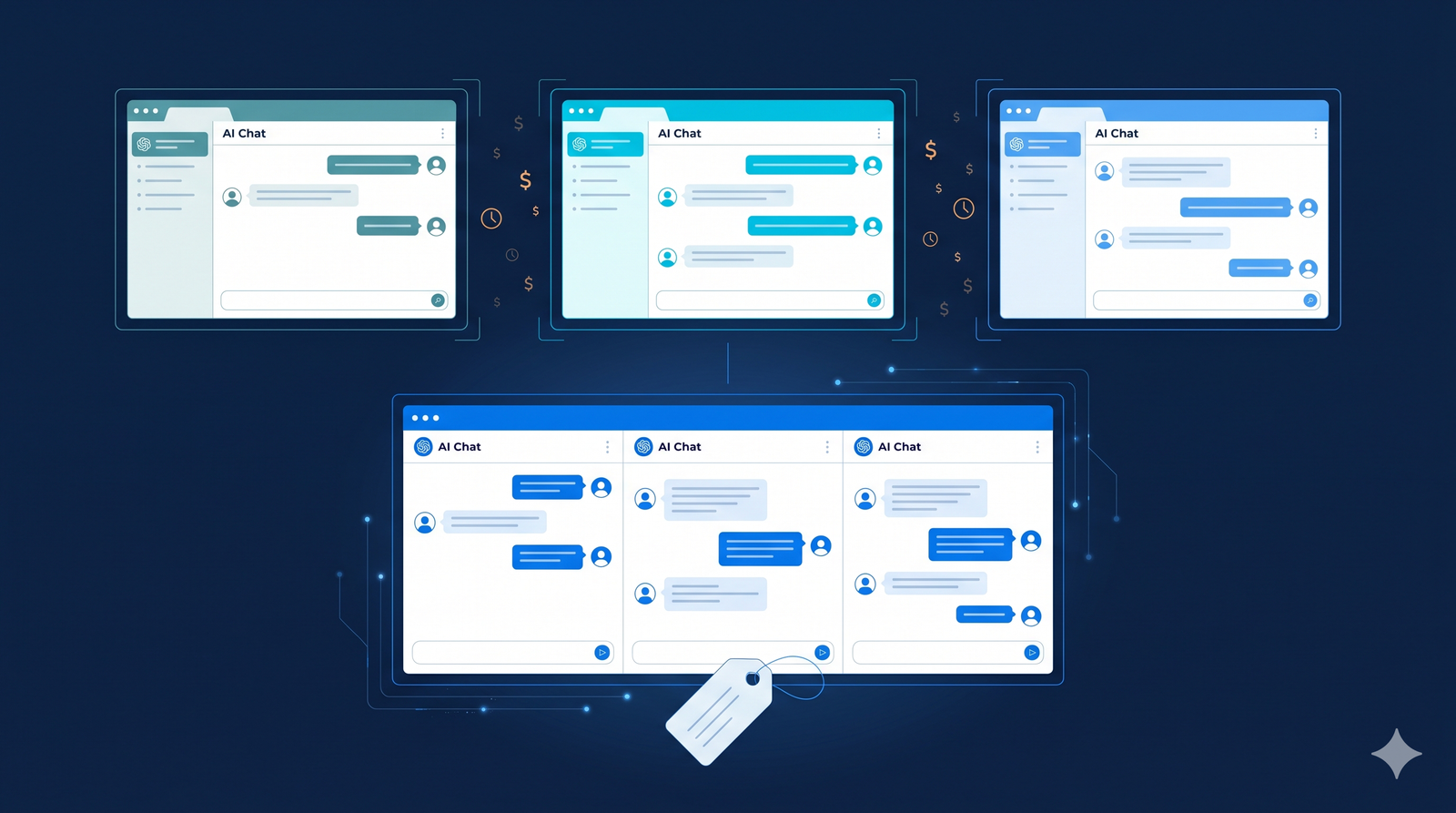
Here is what a typical knowledge worker's AI stack looks like in 2026.
ChatGPT Plus: $20 per month. Claude Pro: $20 per month. Gemini Advanced: $20 per month. That is $60 per month before adding Perplexity ($20), Midjourney ($10), or any other specialized tool.
For a single user, $60 to $100 per month feels manageable. For a 20-person team, it is $14,400 to $24,000 per year. For a 100-person organization, the numbers cross six figures.
And that is just the subscription cost. The actual cost is much higher.
The Visible Cost: Subscriptions
Let's start with the numbers everyone can see.
A professional who subscribes to ChatGPT Plus ($20), Claude Pro ($20), and Gemini Advanced ($20) pays $60 per month or $720 per year. Adding Perplexity Pro for research ($20) brings it to $80 per month or $960 per year.
For teams, multiply by headcount. A 20-person team where everyone has ChatGPT Team ($25/user) and individual Claude Pro accounts ($20/user) pays $540 per month or $6,480 per year. And that gives the team access to only two of the major AI models with basic admin controls and no real governance.
These costs are growing. Zylo's 2026 research found that organizational spending on AI-native applications increased 108% year-over-year. ChatGPT became the number one most-expensed application by transaction volume. The spend is accelerating, not stabilizing.
The Invisible Costs: What Nobody Tracks
Subscription fees are the smallest part of the problem. Four hidden costs make separate subscriptions far more expensive than they appear.
Context Lost Between Platforms
Every time you switch from ChatGPT to Claude because Claude handles your writing task better, you start from scratch. You re-explain your project. You re-enter context. You re-establish your preferences.
If you have been working with ChatGPT on a research project and need Claude to write the final report, Claude has no idea what ChatGPT found. You have to copy and paste everything over, losing formatting and structure in the process.
This context fragmentation means duplicate effort on every cross-platform task. Over a week, the time lost to re-entering context across platforms adds up to hours of productive work.
No Shared Knowledge Across the Team
When one team member develops an excellent prompt for competitive analysis in ChatGPT, that prompt lives in their personal account. Their colleague who needs to do the same analysis starts from zero.
When a team lead uses Claude to create a project framework, it stays in their Claude history. The rest of the team cannot access it, build on it, or reuse it.
Separate subscriptions mean separate knowledge silos. Every person on the team is reinventing workflows that their colleagues have already figured out. There is no shared prompt library, no shared workspace, and no way to learn from each other's AI work.
Zero Governance or Visibility
With separate subscriptions, the organization has no way to answer basic questions. What data is being processed through these tools? Which employees are pasting confidential information into consumer AI tools? How much is the organization actually spending on AI across all individual subscriptions?
There are no audit trails. No policy enforcement. No data protection. No compliance controls. Each employee's AI usage is a black box to the organization.
For any company subject to regulatory requirements, this blind spot is a compliance risk. For any company that handles sensitive client data, it is a data protection risk. For any company that needs to demonstrate AI governance to partners or customers, it is a credibility risk.
Model Lock-In by Habit, Not by Choice
When each person uses their own preferred AI tool, the team develops fragmented expertise. One person becomes an expert at prompting ChatGPT. Another becomes skilled with Claude. A third builds their workflow around Gemini.
Nobody is using the best model for each task. Everyone is using the model they happen to be subscribed to for every task. The writer who is subscribed to ChatGPT uses ChatGPT for writing, even though Claude would produce better output for that specific task. The analyst subscribed to Claude uses Claude for data analysis, even though GPT would handle the numbers better.
The result is suboptimal output across the board, not because the models are bad, but because the wrong model is being used for the wrong task.
What Consolidation Actually Looks Like
A consolidated multi-model platform replaces separate subscriptions with a single interface that provides access to all major AI models. Here is what changes.
One login, all models. Every team member accesses ChatGPT, Claude, Gemini, and dozens of other models through a single platform. No separate accounts. No separate billing. No context lost between tools.
Shared workspaces. When one person develops an effective workflow, the entire team benefits. Shared prompt libraries, project folders, and collaborative workspaces mean knowledge builds across the team instead of staying locked in individual accounts.
Intelligent routing. The platform automatically selects the best model for each task. Writing tasks go to the model that writes best. Analysis tasks go to the model that analyzes best. The user does not need to know or care which model handles each request.
Built-in governance. Every interaction is logged. Data protection is automatic. Policies enforce organizational rules across every user. The governance that was impossible with separate subscriptions becomes standard.
Predictable costs. Instead of tracking and managing five different billing cycles with unpredictable usage, one invoice covers everything. Per-user pricing makes budgeting straightforward.
The Math
Here is the comparison for a 20-person team.
Separate subscriptions: ChatGPT Team ($25/user) plus individual Claude Pro ($20/user) plus Gemini Advanced ($20/user) equals $65 per user per month. Total: $1,300 per month or $15,600 per year. This gives you three models, basic ChatGPT admin controls, no shared workspace across platforms, no governance, and no data protection.
Consolidated platform: All models included at $8 per user per month. Total: $160 per month or $1,920 per year. This gives you 50+ models, shared workspaces, team prompt libraries, full audit trails, automatic data protection, policy enforcement, and intelligent model routing.
Annual savings: $13,680 for a 20-person team. That is an 88% cost reduction with more models, better governance, and team collaboration that separate subscriptions cannot provide.
When Separate Subscriptions Still Make Sense
There are legitimate reasons to keep separate subscriptions in specific cases.
If you are a solo user doing primarily one type of work, a single subscription to the model that handles your work best is simpler and may be sufficient.
If you need API access for custom development, direct provider APIs offer capabilities that multi-model platforms may not fully replicate.
If your usage is extremely light (a few queries per week), free tiers of individual tools may cover your needs without any subscription at all.
But for teams of any size doing diverse work that benefits from multiple models, the case for consolidation is overwhelming. The subscription savings alone justify the switch. The governance, collaboration, and productivity benefits make it compelling.
The Bottom Line
Using ChatGPT, Claude, and Gemini separately is like paying for three different email services, three different calendars, and three different document editors. It technically works, but the duplication, fragmentation, and lack of integration costs more than the subscriptions themselves.
The AI subscription model that made sense in 2023 when there was one dominant tool does not make sense in 2026 when there are dozens of specialized models. The smart approach is not picking the best single model. It is accessing all of them through a single, governed, collaborative platform.
The money you save on subscriptions pays for better results, better governance, and better teamwork. That is not a trade-off. That is just a better way to use AI.