
How to Choose the Right AI Model for Every Task in 2026
Claude excels at writing. GPT leads on analysis. Gemini wins multimodal. This guide maps task types to AI model strengths so you get the best results without paying for models you do not need.
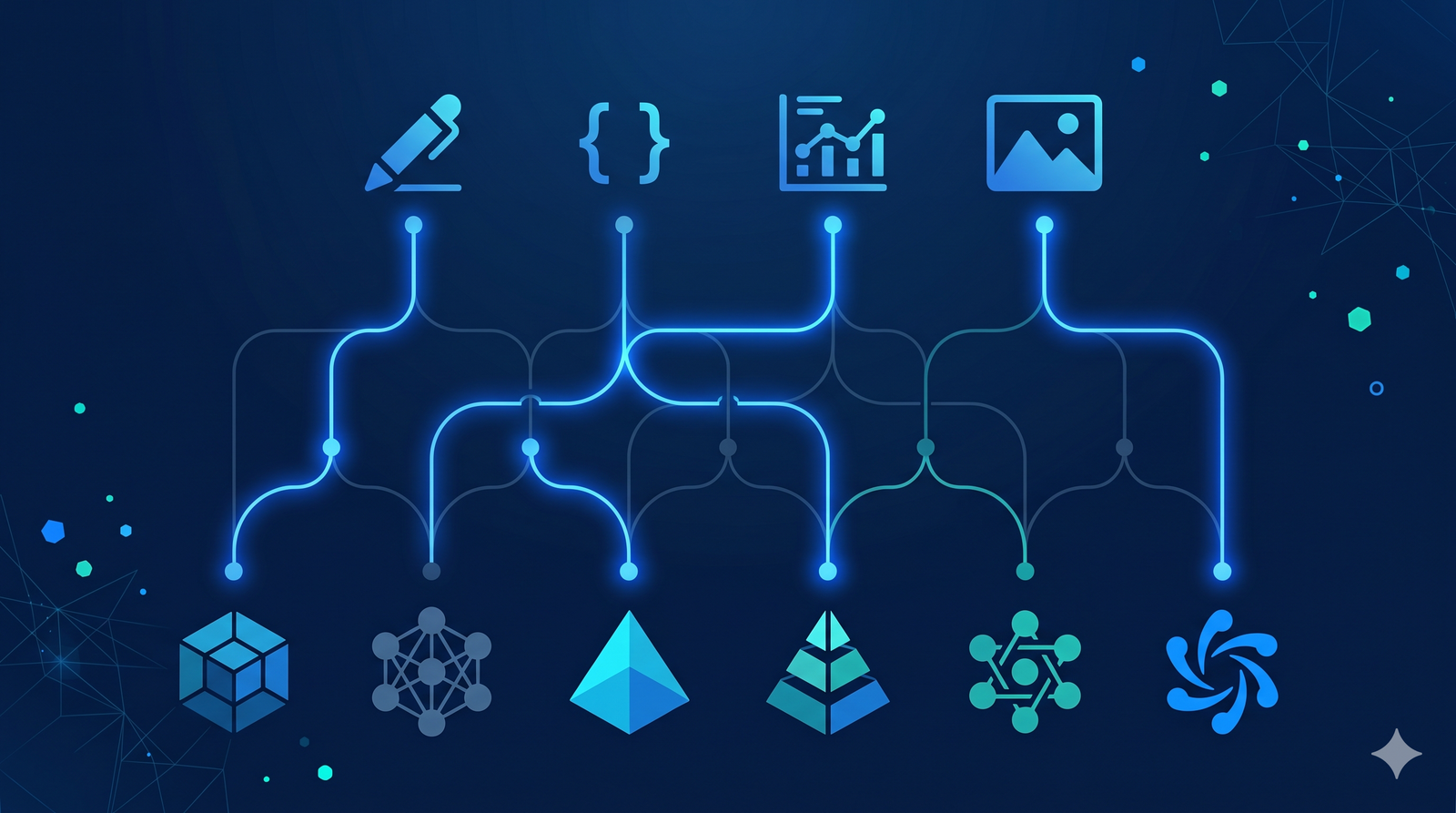
There are over 400 AI models available through routing platforms in 2026. Five major providers compete at the frontier level. Dozens of specialized models target specific domains. And new models launch every month claiming to be the best at everything.
For most people, the question is not "which model exists" but "which model should I use for what I am doing right now." The answer is almost never "the same model for everything."
Benchmarking data consistently shows that no single model wins across all task types. The model that produces the best code is not the same model that writes the best marketing copy. The model that reasons most carefully is not the same model that responds fastest.
This guide maps the major task categories to the models that perform best in each one, based on published benchmarks and practical evaluation as of mid-2026. It also covers cost differences, because using a $15-per-million-token model for a task that a $0.10 model handles equally well is a waste of money.
The Frontier Models: What Each One Does Best
Claude (Anthropic)
Claude Opus 4.6 is Anthropic's current flagship. It supports a 1 million token context window (with no surcharge since March 2026) and features adaptive thinking that lets the model decide when to apply extended reasoning.
Strongest at: Long-form writing and content creation. Code generation, refactoring, and debugging. Tasks requiring deep, sustained reasoning across large documents. Maintaining consistency across very long conversations. Following nuanced, complex instructions with high precision.
Weaker at: Real-time information retrieval (no native web browsing in the base model). Multimodal tasks involving video or audio. Tasks requiring integration with Google Workspace or similar ecosystems.
Best for: Writers, developers, researchers, and anyone working with long documents or complex codebases.
GPT-5.4 (OpenAI)
OpenAI's GPT-5.4 is the most widely deployed model in enterprise environments. Its internal architecture uses a mixture of experts approach, routing different types of requests to specialized sub-models behind a unified interface.
Strongest at: Broad general knowledge across virtually every domain. Structured analysis and data interpretation. Following complex multi-step instructions. Ecosystem integration through plugins, custom GPTs, and enterprise APIs. Tasks requiring balanced performance across multiple capabilities.
Weaker at: Very long-form writing tends to become repetitive. Creative tasks sometimes feel templated. Cost can be high for heavy API usage at the frontier tier.
Best for: Business analysts, general knowledge workers, teams that need a reliable all-rounder.
Gemini 3.1 Pro (Google)
Google's Gemini 3.1 Pro leads on reasoning benchmarks and multimodal understanding. Native integration with Google Workspace gives it unique advantages for organizations in the Google ecosystem.
Strongest at: Multimodal tasks involving images, documents, and mixed media. Reasoning and logical problem-solving. Google Workspace integration (Docs, Sheets, Gmail, Calendar). Grounding responses in real-time Google Search data. Processing complex visual inputs like charts, diagrams, and screenshots.
Weaker at: Long-form writing quality does not match Claude. Code generation is capable but not as refined as Claude or specialized coding models. Less flexible outside the Google ecosystem.
Best for: Teams heavily invested in Google Workspace. Researchers working with visual data. Anyone whose work involves analyzing images, charts, or mixed media alongside text.
DeepSeek (DeepSeek AI)
DeepSeek has emerged as a strong contender in coding and technical tasks, particularly popular among developers who need high performance at lower cost.
Strongest at: Code generation and optimization across multiple programming languages. Technical documentation and API reference creation. Cost efficiency for high-volume technical tasks. Open-source availability for self-hosted deployments.
Weaker at: General business writing. Creative tasks. Broad general knowledge. Enterprise support and compliance certifications.
Best for: Development teams processing high volumes of code-related tasks. Cost-conscious organizations with primarily technical AI needs.
Smaller and Specialized Models
Below the frontier tier, a growing ecosystem of smaller models handles routine tasks at a fraction of the cost. GPT-5 mini delivers roughly 60% of GPT-5.4's benchmark score at just $0.04 per task compared to $0.56 for the frontier model. Claude Haiku is optimized for speed and cost on routine classification, extraction, and formatting tasks.
These models are not just cheaper versions of frontier models. They are specifically optimized for tasks where speed and cost matter more than maximum reasoning depth.
Task-to-Model Mapping
Writing and Content Creation
For blog posts, articles, reports, marketing copy, and any long-form writing where quality matters, Claude consistently produces the most coherent and well-structured output. GPT-5.4 is a close second for shorter content and business writing. Gemini is adequate but tends to produce writing that feels less natural.
For very high-volume content where speed matters more than polish (product descriptions, email templates, social media drafts), smaller models like Claude Haiku or GPT-5 mini handle the task at a fraction of the cost.
Coding and Software Development
Claude Opus leads on complex coding tasks: architecture decisions, refactoring large codebases, and debugging subtle issues. DeepSeek is competitive on straightforward code generation. GPT-5.4 handles general coding well and benefits from the largest ecosystem of developer tools and integrations.
For code review, an emerging best practice is using two models. Microsoft's Copilot Researcher now uses GPT to generate code and Claude to review it for accuracy. This cross-model verification catches errors that either model alone would miss.
Data Analysis
GPT-5.4 is typically the strongest choice for structured data analysis, particularly when working with spreadsheets, databases, and numerical reasoning. Gemini is strong when the analysis involves visual elements like charts and graphs. Claude handles analytical writing well but is not as strong on pure numerical tasks.
Research and Information Synthesis
For broad research across many sources, the model matters less than the architecture. Single-model research hits context window limits on comprehensive tasks. Multi-agent systems that deploy multiple instances of any model outperform single-agent research regardless of which model is used.
For focused research on a specific topic, Claude's large context window (1 million tokens) makes it particularly effective at processing and synthesizing large documents.
Multimodal Tasks
Gemini leads when the task involves images, documents, charts, screenshots, or any combination of visual and text input. If you need to analyze a photograph, interpret a complex diagram, or process a scanned document, Gemini is the strongest choice.
Quick, Routine Tasks
For classification, extraction, summarization of short texts, formatting, and other routine operations, use the cheapest model that handles the task accurately. This is typically Claude Haiku, GPT-5 mini, or similar lightweight models. Using a frontier model for these tasks is like driving a sports car to check the mailbox.
The Cost Dimension
Model selection is not just about quality. It is also about economics.
Frontier models cost roughly $5 to $15 per million input tokens. Mid-tier models cost $0.50 to $3. Lightweight models cost $0.05 to $0.25. For an organization processing thousands of AI tasks per day, the difference between routing routine tasks to a $0.10 model versus a $15 model is enormous.
The practical approach is to use frontier models only when the task requires their full capability. Reserve Claude Opus for complex writing and coding. Reserve GPT-5.4 for deep analysis. Route everything else to the fastest, cheapest model that delivers acceptable quality.
This is exactly what intelligent model routing does. It evaluates each task and matches it to the most cost-effective model that can handle it well. You get frontier quality on hard tasks and commodity pricing on easy ones.
Why Locking Into One Model Is a Mistake
The AI model landscape changes constantly. In the past year alone, leadership positions have shifted multiple times across coding, writing, reasoning, and multimodal benchmarks. The model that is best at coding today may not hold that position six months from now.
Locking into a single model through a single-provider subscription means accepting that provider's weaknesses alongside their strengths. It also means missing out when a competitor releases a model that is better at tasks critical to your work.
Multi-model platforms solve this by giving you access to all major models through a single interface. When a new model launches that outperforms the current leader on your key tasks, you switch models without changing your workflow, rewriting your prompts, or disrupting your team.
The question is not "which model is the best." It is "which model is the best for this specific task, right now." The answer changes depending on the task. And the answer changes over time as models improve. The architecture that handles both of those realities is one that supports multiple models with intelligent routing, not one that bets everything on a single provider.
The Bottom Line
The era of one model for everything is ending. Specialization has become the defining characteristic of the 2026 AI model landscape.
The practical implications are clear. Know which model is strongest for your most common tasks. Use frontier models for hard problems and lightweight models for routine work. Do not lock into a single provider. And if possible, use a platform that handles model selection automatically so you can focus on the work instead of the model.
The best model for your task might not be the one you are currently using. And the best model for your task six months from now might not exist yet. Build your workflow around flexibility, not loyalty to a single provider.