
AI Cost Management: How Teams Are Cutting AI Spend by 70% Without Losing Capability
Teams spend $60 or more per user on separate AI subscriptions with no governance. Learn how consolidation and model routing cut AI costs by 70% while improving results.
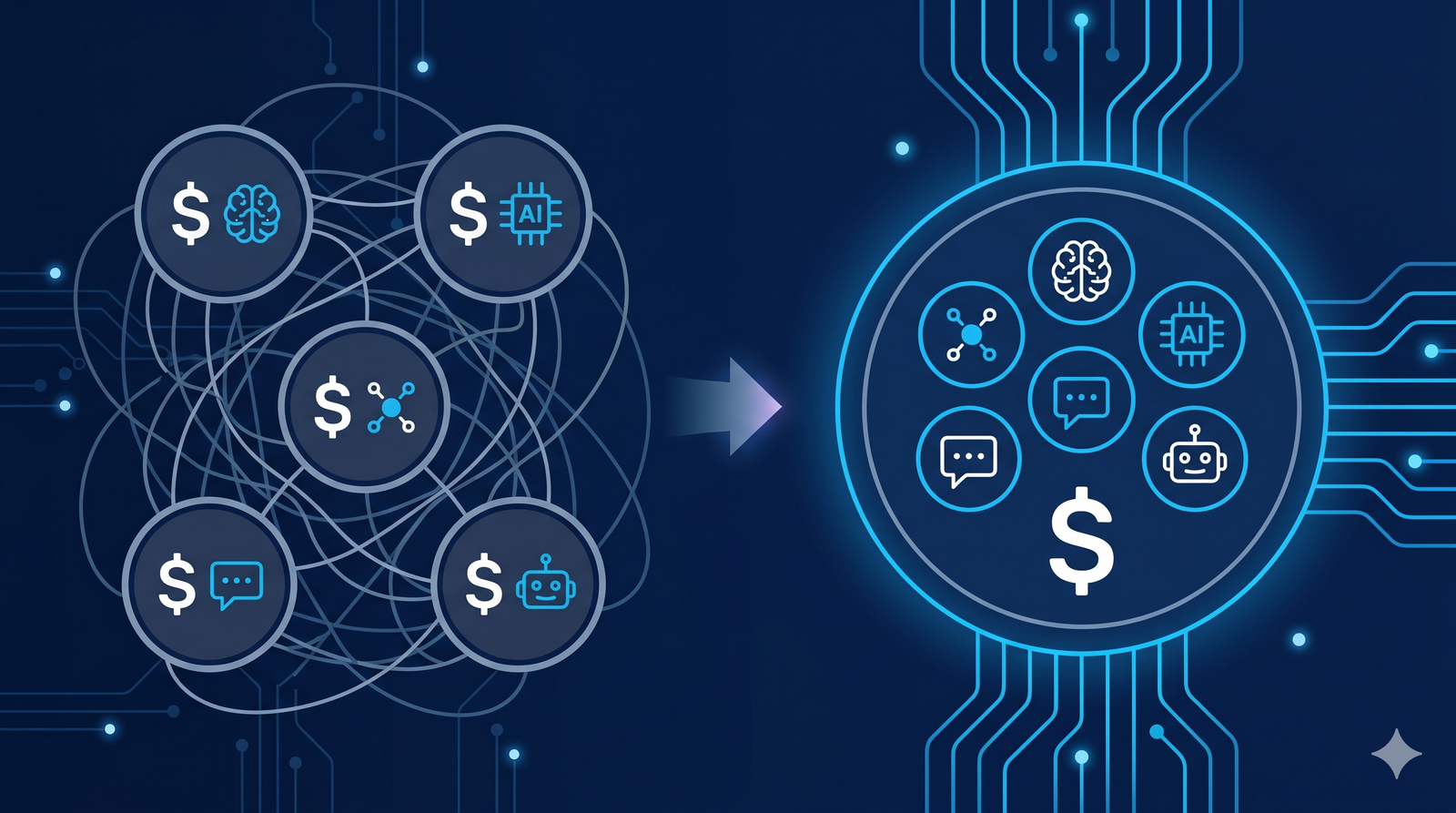
ChatGPT Plus costs $20 per month. Claude Pro costs $20 per month. Gemini Advanced costs $20 per month. Perplexity Pro costs another $20 per month.
That is $80 per user per month before you have added a single team feature, governance control, or audit trail. For a 20-person team, you are looking at $19,200 per year across four separate platforms with four separate logins, four separate billing cycles, and zero shared context.
According to Zylo's 2026 SaaS Management Index, organizations spent an average of $1.2 million on AI-native applications last year, a 108% increase from the prior year. ChatGPT became the number one most-expensed application by transaction volume. Individual professionals routinely maintain three to five active AI subscriptions simultaneously.
The AI cost problem is not that these tools are expensive individually. It is that duplicate subscriptions, zero governance, context-switching overhead, and lack of usage visibility combine to create spending that grows faster than the value it delivers.
This article breaks down where AI costs actually come from, why they grow uncontrollably, and how teams are cutting spending by 70% while getting better results.
Where the Money Actually Goes
Most people think about AI cost as subscription fees. The subscription is actually the smallest part of the total cost.
Subscription Sprawl
The average knowledge worker now uses three to five AI tools. Each one serves a slightly different purpose. ChatGPT for general tasks. Claude for writing. Gemini for integration with Google Workspace. Midjourney for images. Perplexity for research.
Each tool costs $20 to $30 per month. Individually, each expense seems justified. Together, they create a $100+ per user per month line item that nobody approved, nobody tracks, and nobody optimizes.
For teams, the math is worse. When 20 employees each expense AI tools individually, the organization pays retail pricing with no volume discounts, no consolidated billing, and no way to know which tools are actually delivering value.
The Context-Switching Tax
Every time you leave one AI platform and open another, you lose context. Research on knowledge worker productivity shows that switching between tools costs 20 to 30 minutes of deep focus each time. If you jump between five AI platforms a dozen times per day, you are losing hours of productive time that does not show up on any invoice.
This is the hidden cost that makes AI subscription sprawl so expensive. The lost productivity from managing multiple tools often exceeds the subscription costs themselves.
No Usage Visibility
When AI tools are purchased individually by employees, the organization has no way to measure usage, value, or waste. Are all 20 ChatGPT licenses being used actively? Is anyone using Claude for tasks that the free tier of another tool handles just as well? Is the team getting measurable results from their AI spend?
Without usage data, you cannot optimize. You cannot identify unused licenses. You cannot make informed decisions about renewals. You are spending based on individual preferences instead of organizational needs.
Governance as a Hidden Cost
Consumer AI tools do not include audit logging, data protection, or compliance features. For organizations that need these capabilities, adding governance means purchasing additional tools on top of the AI subscriptions themselves.
Shadow AI detection tools cost $5,000 to $50,000 per year. Data loss prevention platforms that monitor AI interactions add another layer of expense. Compliance auditing for AI usage requires staff time and specialized tools. The total cost of governing ungoverned AI tools often exceeds the cost of the AI tools themselves.
Why Token-Based Pricing Makes This Worse
The AI industry is shifting from flat-fee subscriptions toward token-based, consumption-based pricing. GitHub Copilot recently switched from a flat monthly fee to a credit system where different actions consume different amounts of credits. OpenAI's API pricing is token-based. Enterprise AI costs increasingly correlate with usage volume.
This shift makes cost management harder for two reasons.
First, usage is unpredictable. A simple task might consume a few hundred tokens. A complex research task might consume hundreds of thousands. Without monitoring, monthly costs swing wildly based on what work gets done.
Second, expensive models get used for everything. When users have access to a frontier model, they use it for simple tasks that a cheaper model handles equally well. A $15-per-million-token model classifying support tickets burns money when a $0.10-per-million-token model delivers identical accuracy for that task.
Uber's CTO recently admitted that the company exhausted its entire 2026 AI budget on coding tools alone, primarily Anthropic's Claude. Without cost governance, AI spending has a tendency to run ahead of budgets.
How Teams Are Cutting AI Costs by 70%
The organizations that have solved the AI cost problem share a common approach: consolidation, intelligent routing, and governance. Here is how each piece works.
Consolidation: One Platform Instead of Five
The most impactful cost reduction comes from replacing multiple individual subscriptions with a single platform that provides access to all major AI models through one interface.
Instead of $20 for ChatGPT plus $20 for Claude plus $20 for Gemini, a consolidated multi-model platform gives every team member access to all of these models (and more) for a single per-user fee that is typically $8 to $15 per month.
For a 20-person team, this changes the math dramatically. Five separate subscriptions at $20 each per user equals $2,000 per month or $24,000 per year. A consolidated platform at $8 per user equals $160 per month or $1,920 per year. That is a 92% cost reduction on subscription fees alone.
But the savings go beyond subscriptions. Consolidation eliminates context-switching between platforms. It provides a single audit trail instead of five separate logging systems. It gives leadership visibility into AI usage across the entire team. And it removes the need for separate governance tools because compliance features are built into the platform.
Intelligent Model Routing: Right Model for Each Task
Not every task needs the most expensive model. A quick classification task does not need Claude Opus. A simple summary does not need GPT-5.4.
Intelligent model routing automatically matches each task to the most cost-effective model that can handle it well. Simple tasks go to fast, cheap models. Complex reasoning goes to frontier models. The user does not need to know which model is handling their request. They describe what they need, and the system optimizes for both quality and cost.
Studies suggest this approach reduces AI costs by 40 to 60% compared to using a single premium model for everything, while maintaining or even improving output quality. The savings come from the fact that 70 to 80% of typical AI tasks are routine enough to be handled well by smaller, cheaper models.
Usage Visibility: Track What You Spend
You cannot cut costs you cannot see. Consolidated platforms with built-in analytics show exactly who uses what, how often, and at what cost. This data enables several optimizations.
Identifying unused or underused licenses. If five team members have AI access but only three use it regularly, you can right-size your subscription.
Spotting expensive usage patterns. If one team member's usage is 10 times the team average, understanding why leads to either optimization or justification of the spend.
Forecasting future costs. With usage data, you can project spending and set budgets that actually hold instead of getting surprised by overages.
Proving ROI. When leadership asks whether AI spend is worth it, usage data combined with output data tells the story. Without it, you are defending an expense with anecdotes.
The Governance Dividend
Organizations that consolidate AI under a governed platform get a financial bonus beyond direct cost savings: they stop paying for governance separately.
When every AI interaction flows through a single platform with built-in audit logging, data protection, and policy enforcement, the need for separate shadow AI detection tools, data loss prevention overlays, and compliance monitoring decreases significantly.
The numbers make this clear. A 20-person team with ungoverned AI might spend $500 per month on separate AI subscriptions, $200 per month on shadow AI detection, and uncounted hours on manual compliance monitoring. A governed, consolidated platform might cost $160 per month and include all of those capabilities.
The total cost of ownership, not just the subscription price, is what matters. The cheapest AI tool is expensive if you have to layer governance on top of it.
A Practical Cost Reduction Playbook
Here is a step-by-step approach to cutting your organization's AI costs this quarter.
Week 1: Audit. Pull all AI-related expenses from the past three months. Include individual subscriptions, team plans, API costs, and any governance or monitoring tools purchased to manage AI usage. Calculate total spend per user.
Week 2: Evaluate consolidation options. Research multi-model platforms that provide access to multiple AI models through a single interface. Compare the per-user cost of a consolidated platform against your current total spend. Factor in governance features that the consolidated platform includes.
Week 3: Pilot. Deploy the consolidated platform to a small team (five to ten people). Cancel their individual subscriptions. Run both systems in parallel for one week to validate that the consolidated platform meets their needs.
Week 4: Measure and roll out. Compare costs, usage patterns, and user satisfaction between the pilot group and the rest of the organization. If the pilot succeeds, roll out to additional teams and cancel remaining individual subscriptions.
Most organizations see measurable cost reduction within 30 days of consolidation. The longer-term benefits, including governance, visibility, and reduced context-switching, compound over the following months.
The Bottom Line
AI is not inherently expensive. Unmanaged AI is expensive.
The organizations paying $60 to $100 per user per month across multiple ungoverned subscriptions are not getting twice the value of organizations paying $8 to $15 per user per month on a consolidated, governed platform. They are getting the same or worse results with less control and more risk.
The fix is straightforward: consolidate tools, route tasks intelligently, and gain visibility into usage. The technology to do this exists today. The only barrier is the organizational will to stop paying five separate AI bills and start paying one.
Your AI spend should be an investment with measurable returns. Not a growing line item that nobody controls.