
The Agentic AI Shift: From Copilots to AI That Executes
The AI industry is shifting from copilots that assist to agents that execute. Learn what's driving the change, what it means for teams, and how to prepare for agentic AI in 2026.
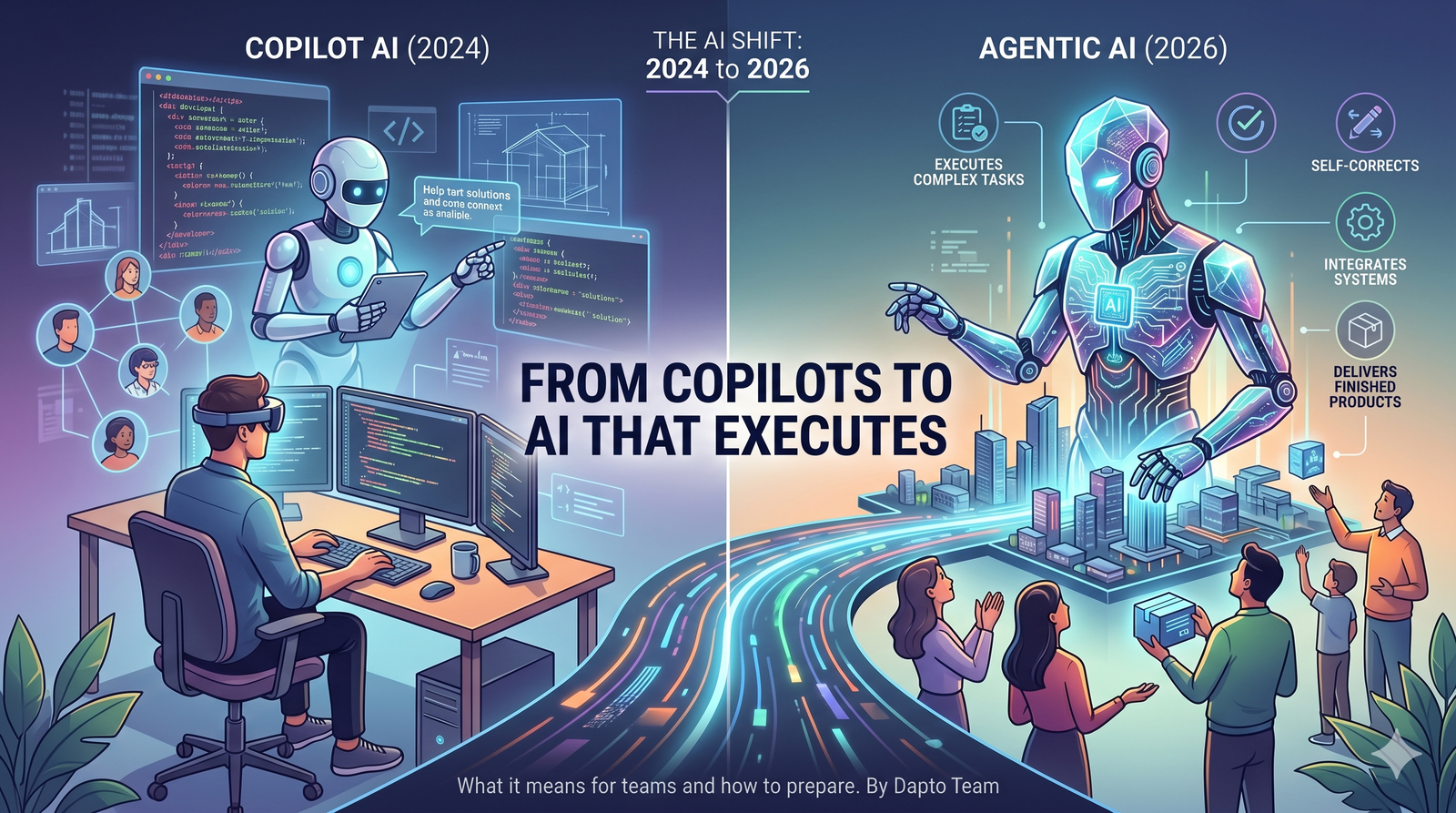
In 2025, we learned how to talk to AI. In 2026, we're learning how to let AI work.
That one sentence captures the biggest shift happening in enterprise technology right now. AI is moving from a tool that responds to prompts into a system that executes work autonomously. The industry calls this the shift from copilots to agents. And it's happening faster than most organizations expected.
Microsoft's Copilot is evolving from a helpful assistant into a platform of specialized autonomous agents. Valeo, a global automotive supplier with 100,000 employees, reports that 35% of its code is now generated or optimized by AI. Over half of all enterprises have AI agents running in production today.
This article explains what changed, why it matters, and how teams should think about the transition.
What Copilots Do — And Where They Stop
AI copilots changed how people work. That's not in question. GitHub Copilot helped developers write code faster. Microsoft 365 Copilot summarized meetings, drafted emails, and pulled insights from spreadsheets. Google's Gemini helped researchers synthesize information.
But copilots share a fundamental design: they assist one task at a time, and they wait for you to tell them what to do next.
You prompt. They respond. You review. You prompt again. You assemble the final result yourself. The copilot accelerates individual steps, but the overall workflow — the planning, sequencing, assembling, and quality checking — stays on you.
This is fine for simple tasks. But for complex work that involves multiple steps, multiple tools, and multiple data sources, the copilot model breaks down. Not because the AI isn't smart enough, but because the architecture puts all coordination responsibility on the human.
As one industry analyst put it: a copilot operates at the level of the individual interaction. An agent operates at the level of the workflow. In most organizations, the bottleneck isn't the individual task — it's the coordination between tasks.
What Makes an AI Agent Different
An AI agent doesn't wait for your next prompt. You give it a goal, and it figures out the steps, executes them across tools and systems, and delivers a finished result.
The distinction matters at every level.
A copilot drafts an email. An agent monitors your inbox, identifies which messages need responses, drafts appropriate replies matching your tone, and queues them for your review.
A copilot summarizes a document. An agent reads 200 documents, extracts relevant information from each one, cross-references the data, and produces a comprehensive analysis with citations.
A copilot suggests code. An agent writes the feature, creates tests, runs them, fixes bugs, and opens a pull request — while you work on something else.
The shift is from "AI helps me do my work" to "AI does the work, and I review the output." The human role moves from executor to supervisor.
Why the Shift Is Happening Now
Three forces are converging to make agentic AI viable in 2026 in a way it wasn't before.
AI Models Are Good Enough to Plan
Early large language models could generate text, but they couldn't reliably plan multi-step workflows. They'd skip steps, repeat actions, or lose track of what they'd already done.
Current models — particularly reasoning-focused models from Anthropic, OpenAI, and Google — can break goals into subtasks, sequence those tasks correctly, and adjust the plan when things go wrong. Planning used to be the weakest link. It's now reliable enough for production use.
Tool Use Has Matured
Agents need more than language ability. They need to interact with the real world — browse websites, read files, run code, query databases, call APIs, and generate documents.
In 2025, tool use was experimental. In 2026, it's standard. Protocols like the Model Context Protocol (MCP) have standardized how AI agents connect to external tools and data sources. This means agents can reliably work across multiple systems without custom integration for each one.
The Economics Changed
Running autonomous agents used to be expensive. Multi-step workflows consumed massive amounts of tokens. But model costs have dropped dramatically while efficiency has improved. Smaller, faster models handle routine subtasks cheaply. Expensive frontier models are reserved only for complex reasoning.
GitHub's recent shift to token-based billing tells the story: AI usage has moved from an experimental perk to core infrastructure that organizations budget for and optimize around. The economics now favor agents over manual human workflows for high-volume, repetitive tasks.
What McKinsey's Data Tells Us
McKinsey's 2025 State of AI report, covering nearly 2,000 organizations across 105 countries, reveals the core tension of this transition.
88% of organizations now use AI in at least one business function — up from 78% the prior year and 20% in 2017. Adoption is nearly universal.
But only 6% qualify as AI "high performers" — organizations generating measurable revenue and efficiency gains from AI. That means 94% of organizations are using AI without getting transformative results.
What separates the 6% from the rest? The high performers are three times more advanced in agent deployment. They've moved past using AI for individual task assistance and into using it for autonomous workflow execution.
The gap between "we use AI" and "AI generates real business value" is exactly the gap between copilots and agents.
The Multi-Model Reality
One of the less obvious but most important aspects of the agentic shift is the move from single-model to multi-model architectures.
During the copilot era, most organizations standardized on one AI provider. You used ChatGPT, or you used Claude, or you used Gemini. One model for everything.
That approach breaks down with agents because different models genuinely excel at different tasks. Research from multiple benchmarking studies in 2026 consistently shows that no single model is best at everything. Claude tends to outperform on long-form writing and code. GPT excels at structured analysis and broad knowledge. Gemini leads on multimodal understanding. Specialized models from DeepSeek and others dominate specific technical domains.
Microsoft recognized this when it updated its Copilot Researcher agent to use multiple models. A GPT model drafts the response. An Anthropic Claude model reviews it for accuracy. Microsoft's VP of Design and Research explained their reasoning simply: two models are better than one.
IDC's 2026 AI FutureScape predicts that by 2028, 70% of top AI-driven enterprises will use advanced multi-model architectures to dynamically manage model routing. Even major AI providers are already doing this internally — many frontier models are actually "mixtures of experts," where different specialized sub-models handle different types of requests behind a unified interface.
For teams evaluating AI agent platforms, this has a practical implication: look for platforms that support multiple models and intelligent routing, not ones locked to a single provider.
What's Actually Changing in the Enterprise
The copilot-to-agent shift isn't theoretical. Here's what it looks like on the ground.
The Nature of Work Is Changing
Copilots made existing workers faster. Agents are changing which tasks humans do at all.
In the copilot model, a financial analyst uses AI to help summarize data. In the agent model, AI processes the data end-to-end and produces the summary. The analyst's role shifts from producing the analysis to reviewing it, questioning the methodology, and deciding what to do with the findings.
This pattern is repeating across functions. In customer service, agents resolve routine issues without human involvement. In sales, agents handle lead research and initial outreach. In operations, agents monitor systems and trigger responses automatically.
The McKinsey report found a 34% productivity increase among workers using AI tools in 2026. But productivity means something different now. It's not "doing the same work faster." It's "spending time on higher-value work because AI handles the routine."
Governance Is Becoming the Competitive Advantage
When AI was a copilot assisting individual tasks, governance was optional. If the copilot suggested a bad email draft, you just rewrote it. No harm done.
When AI agents execute multi-step workflows autonomously — updating databases, sending communications, making calculations, triggering business processes — governance becomes critical. A bad agent action can affect real systems, real customers, and real money.
Only 21% of companies currently have a mature AI agent governance model. Gartner projects that over 40% of agentic AI projects will be canceled by 2027, with weak governance cited as a primary driver.
The organizations pulling ahead aren't just the ones with the best AI models. They're the ones with the best governance: audit trails that show what every agent did and why, policy enforcement that prevents agents from accessing data they shouldn't, usage visibility that tracks costs and performance across every agent interaction.
Governance isn't a constraint on innovation. It's what makes real deployment possible. Without it, legal and compliance teams block production rollouts — and they're right to.
Pricing Models Are Evolving
The copilot era ran on simple per-seat subscriptions. $20 per user per month. All-you-can-eat access.
That model doesn't work for agents. Agentic workflows consume dramatically more computing resources than simple chat interactions. GitHub's recent switch from flat-fee subscriptions to token-based billing is the clearest signal: as AI moves from assistance to execution, pricing moves from fixed-fee to consumption-based.
Microsoft is exploring similar transitions — tiered capability licensing, transaction-based pricing, and even value-based models where cost ties to measurable business outcomes.
For enterprise buyers, this means AI budgeting needs to evolve. It's no longer a per-seat line item. It's infrastructure spending that needs monitoring, optimization, and cost governance — much like cloud computing spend a decade ago.
How to Prepare for the Agentic Shift
The transition from copilots to agents won't happen overnight. Most organizations will run both in parallel for years. Here's a practical framework for moving forward.
Start With High-Volume, Repeatable Workflows
Don't start with complex strategic work. Start with tasks that happen frequently, follow consistent steps, and don't require nuanced judgment. Processing data, generating reports, researching leads, updating records. These are the workflows where agents deliver immediate, measurable value with the lowest risk.
Build Governance Before You Scale
Set up audit logging, access controls, and usage monitoring before your first agent goes into production. Retrofitting governance after agents are already running is expensive and risky. The organizations succeeding with agentic AI in 2026 treated governance as infrastructure, not an afterthought.
Evaluate Platforms on Execution, Not Conversation
The copilot era trained us to evaluate AI on how well it responded to prompts. The agent era requires a different test: give it a real task, step away, and evaluate the finished output. Can it produce a deliverable you'd actually use? Does quality hold up at scale? Those are the questions that matter now.
Plan for Multi-Model
Don't lock into a single AI provider. Models improve and leapfrog each other constantly. The platform that uses the best model for each task today will outperform the one locked to a single vendor. Look for model flexibility and intelligent routing.
Rethink Roles, Not Headcount
The most common mistake in AI adoption is framing it as replacement. The evidence consistently shows that the biggest gains come from redesigning roles — shifting human effort from execution to oversight, from production to quality control, from routine work to strategic thinking. The organizations that approach agents as "how do we automate away jobs" consistently underperform those that approach it as "how do we free people to do higher-value work."
The Bottom Line
The shift from copilots to agents is the shift from AI that helps you work to AI that does the work. It's the most significant change in enterprise AI since ChatGPT launched in 2022.
The technology is ready. Over half of enterprises have agents in production. The models can plan and execute. The tooling infrastructure has matured. The economics work.
What's still being figured out is the human side: governance, organizational design, trust, and the evolution of work itself.
The organizations that navigate this transition well won't necessarily be the ones with the most advanced AI technology. They'll be the ones that build the right systems around it — governance that enables rather than blocks, roles that evolve rather than disappear, and architectures that scale with confidence rather than break under load.
The copilot era was about learning to work with AI. The agent era is about learning to manage AI that works for you.