AI Chatbot Pricing: Fixed Monthly vs Per-Conversation Pricing
Compare fixed monthly AI chatbot pricing with per-conversation, per-resolution, and credit-based pricing. Learn which model is better for website lead generation, support, and appointment booking.
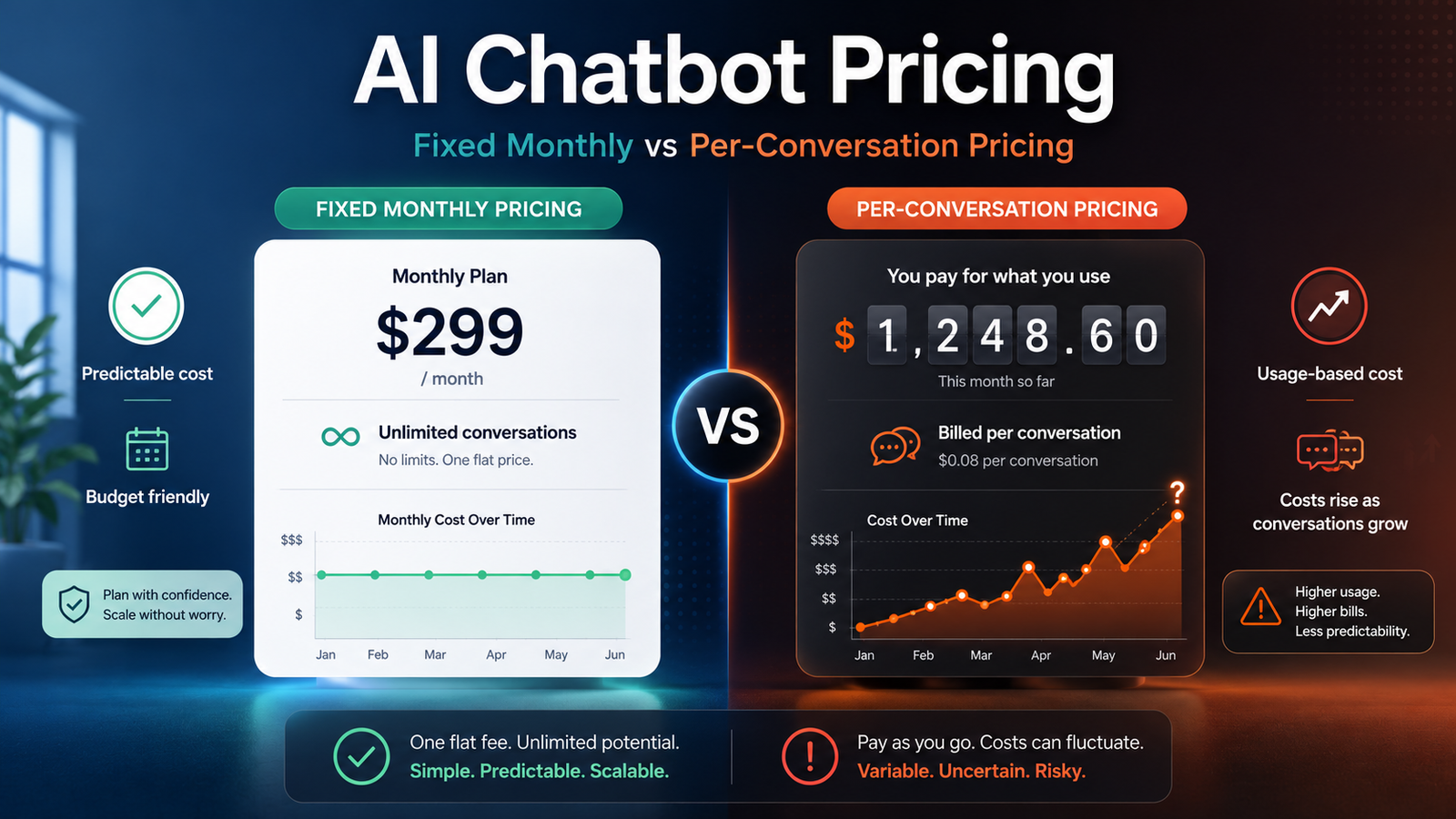
AI Chatbot Pricing: Fixed Monthly vs Per-Conversation Pricing
AI chatbot pricing can look simple on the surface, but the real cost depends on how the vendor charges you when people actually use the chatbot.
Some tools charge a fixed monthly subscription. Others charge by message credits, billable conversations, AI conversations, automated resolutions, successful outcomes, or platform credits. That difference matters a lot if your website chatbot is used for lead generation, appointment booking, quote requests, or customer support.
For a business website, the best pricing model is usually the one that stays predictable when traffic increases. If your chatbot is supposed to talk to more visitors, qualify more leads, and book more meetings, you should not be punished every time the chatbot does its job.
That is why many businesses compare two pricing models before choosing a chatbot:
- Fixed monthly pricing, where you pay one predictable subscription price.
- Usage-based pricing, where your cost grows based on conversations, messages, outcomes, resolutions, or credits.
This guide explains how both models work, when each one makes sense, and how to choose the right model for your website.
Quick Answer
A fixed monthly AI chatbot plan is usually better for businesses that want predictable costs, high website engagement, lead qualification, quote requests, and meeting booking. Per-conversation or usage-based pricing can work for support teams that want to pay only when the AI produces a measurable resolution, but it can become hard to forecast when website traffic, campaigns, or seasonal demand increases.
For Dapto Frontdesk, the goal is simple: your website should be able to answer questions, qualify visitors, collect lead details, handle quote requests, and book meetings without creating anxiety about every extra visitor conversation.
What is fixed monthly AI chatbot pricing?
Fixed monthly pricing means you pay a set monthly fee for access to the chatbot platform and its included features. Depending on the vendor, the plan may include limits around seats, websites, integrations, support level, or usage. A true fixed-price model should make your monthly cost easy to understand before you launch.
For a website chatbot, fixed pricing is attractive because the chatbot is supposed to increase visitor engagement. More conversations should be a good thing. If every conversation adds cost, marketing success can create billing anxiety.
Fixed monthly pricing is best when you want:
- Predictable monthly cost
- Unlimited or high-volume visitor conversations
- Lead qualification without worrying about usage spikes
- Appointment booking from website traffic
- Quote request collection
- Simple budgeting for small businesses
- A chatbot that can be promoted through ads, SEO, and campaigns
What is per-conversation AI chatbot pricing?
Per-conversation pricing means the vendor charges based on the number of conversations the chatbot handles. Some vendors use similar models but call the unit something else, such as billable conversations, AI conversations, automated resolutions, outcomes, or credits.
The exact definition matters.
A “conversation” may mean one visitor chat. A “resolution” may mean the AI answered the customer without further help. An “outcome” may include a resolution, disqualification, or configured handoff. A “credit” may be consumed every time the AI responds, resolves an issue, performs an action, or completes a task.
That is why you should never compare chatbot tools only by the monthly sticker price. You need to understand what happens when usage grows.
Common AI chatbot pricing models
| Pricing model | How it works | Best for | Main risk |
|---|---|---|---|
| Fixed monthly | One predictable monthly subscription | Website lead generation, small business sites, appointment booking, quote requests | May include limits depending on the vendor |
| Per conversation | Cost grows with each chat conversation | Teams with stable and predictable chat volume | Cost increases as more people engage |
| Per resolution | Cost applies when the AI resolves a support issue | Customer support teams measuring deflection | Definitions can be complex |
| Per outcome | Cost applies when the AI completes a defined outcome | Support and workflow automation | Harder to forecast if volume changes |
| Message credits | AI responses consume credits | Flexible AI usage across models and features | Credits can run out or require auto-recharge |
| Seat-based plus usage | Pay for team seats plus usage charges | Larger support teams | Multiple cost drivers |
| Platform credits | Actions consume platform credits | Existing CRM or platform users | Pricing can be hard to map to website ROI |
Examples from the market
Pricing changes often, so always verify the current pricing page before buying. As of July 2026, these examples show how different chatbot vendors structure usage.
Chatbase
Chatbase plans include monthly message credits. Its pricing page lists a free plan with 50 message credits per month, a Hobby plan with 500 message credits per month, a Standard plan with 4,000 message credits per month, and a Pro plan with 15,000 message credits per month. Chatbase also lists auto-recharge credits as an add-on priced per 1,000 message credits.
Source: Chatbase Pricing
Intercom Fin
Intercom lists Fin AI Agent usage as $0.99 per outcome. Intercom’s pricing page also notes additional usage charges for features like WhatsApp conversations, SMS messages, email campaigns, and phone usage.
Source: Intercom Pricing and Fin AI Agent Outcomes
Tidio
Tidio’s pricing page shows plans that scale by billable conversations. It also lists Lyro AI Agent as a standalone product starting from a set monthly price with a defined number of Lyro AI conversations.
Source: Tidio Pricing
Zendesk
Zendesk lists support plans by agent seat, and its Suite Team plan includes AI Agents. Zendesk also explains that AI agents pricing is measured in automated resolutions, replacing earlier monthly active user pricing for Zendesk bots and Answer Bot resolutions.
Source: Zendesk Pricing and Zendesk Automated Resolutions
HubSpot Customer Agent
HubSpot announced that Customer Agent pricing uses HubSpot Credits, with Customer Agent charged at 50 credits per resolution. HubSpot also explains that credits are required for usage-based features such as Customer Agent, Prospecting Agent, Data Agent, and Data Studio syncs.
Source: HubSpot Customer Agent Pricing Update and HubSpot Credits
Why usage-based pricing can be risky for website lead generation
Usage-based pricing is not always bad. In customer support, paying per resolution can make sense if the AI replaces work that a human support agent would otherwise handle.
But website lead generation is different.
A website chatbot is not only there to reduce support cost. It is there to create more conversations. It should encourage visitors to ask questions, explain their needs, request quotes, book meetings, and share buying context.
That means high usage is the goal.
If every additional conversation increases your bill, you may start doing the wrong things:
- Hiding the chatbot on fewer pages
- Avoiding proactive prompts
- Limiting campaign traffic
- Reducing qualification questions
- Turning off useful follow-up flows
- Worrying about low-intent visitors consuming credits
- Treating visitor engagement as a cost instead of an opportunity
That is not how a front desk should work.
Your website front desk should welcome every visitor, not meter every question.
The hidden cost problem
The biggest problem with AI chatbot pricing is not always the base price. It is the combination of base price, usage limits, add-ons, seats, integrations, AI actions, and overages.
A plan may look affordable until you need:
- More conversations
- More AI responses
- More websites
- More team members
- CRM integration
- Calendar booking
- Human handoff
- Advanced analytics
- More training content
- Support ticket creation
- Auto-recharge credits
- Removal of branding
- Custom workflows
For a small business, the worst pricing experience is not simply “expensive.” It is unpredictable.
If the monthly bill changes because of traffic, ad campaigns, seasonal demand, or a viral post, it becomes harder to treat the chatbot as a reliable growth channel.
Fixed monthly vs per-conversation pricing
| Question | Fixed monthly pricing | Per-conversation or usage-based pricing |
|---|---|---|
| Is the monthly cost predictable? | Usually yes | Not always |
| Does cost rise when traffic rises? | Not if usage is included | Usually yes |
| Is it good for lead generation? | Strong fit | Can become expensive as engagement grows |
| Is it good for customer support deflection? | Good if volume is known | Good if tied to real resolutions |
| Is it easy for small businesses to understand? | Yes | Sometimes confusing |
| Does it encourage more conversations? | Yes | Sometimes no |
| Does it work well with paid ads? | Yes, because cost is easier to forecast | Risky if ad traffic creates many paid conversations |
| Does it work well for quote requests? | Yes | Depends on whether every chat, answer, or outcome is charged |
| Best fit | Growth-focused websites | Support teams with measurable resolution goals |
When fixed monthly pricing is the better choice
Fixed monthly pricing is usually better when your chatbot is part of your sales and marketing funnel.
Use fixed pricing when your chatbot needs to:
- Answer questions from website visitors
- Convert anonymous visitors into leads
- Ask qualification questions
- Collect budget, timeline, service needs, and contact details
- Book meetings with your team
- Capture quote requests
- Route inquiries to sales or support
- Support traffic from ads, SEO, email campaigns, or social media
For example, imagine a service business running Meta ads to a landing page. If the campaign works, the chatbot may handle hundreds of extra conversations. That should be a success. With a fixed-price model, the business can treat those conversations as part of customer acquisition. With usage-based pricing, the business has to watch both ad spend and chatbot spend at the same time.
When per-conversation or per-resolution pricing can make sense
Usage-based pricing can make sense when the value of each completed interaction is clear.
For example, a support team may decide that paying per automated resolution is reasonable if each AI resolution replaces a support ticket that would otherwise require human time.
This model can work when:
- You have stable support volume
- You can measure deflection accurately
- You know the value of each resolved issue
- You are using the AI agent mainly for support, not lead generation
- You have enough reporting to audit what counts as a billable outcome
The challenge is that website sales conversations are not always that clean. A visitor may ask three questions, leave, return later, request a quote, or book a meeting after several touches. In that environment, fixed pricing is easier to budget.
The real question: are you paying for usage or growth?
When choosing AI chatbot pricing, ask this:
Do I want to pay more because more visitors are talking to my website?
For support teams, maybe the answer is yes, if the AI is resolving real support tickets.
For lead generation, the answer is usually no. More visitor conversations should mean more learning, more leads, more meetings, and more revenue opportunities.
If your chatbot is part of your front desk, pricing should not make you hesitate to engage visitors.
Cost scenarios
These examples are simplified. They are not vendor-specific quotes. Use them to think through your own buying decision.
Scenario 1: Small business with steady traffic
A local service business gets 1,500 website visitors per month. Around 5 percent start a chat, which means 75 conversations per month.
In this case, both fixed and usage-based pricing may be manageable. The main decision is less about cost and more about features:
- Can the chatbot answer service questions?
- Can it ask qualification questions?
- Can it book appointments?
- Can it collect quote request details?
- Can it route urgent requests correctly?
Scenario 2: Business running paid ads
A B2B service company runs paid ads and sends traffic to a landing page. Website chat volume jumps from 100 conversations to 600 conversations in one month.
With fixed pricing, the company knows the chatbot cost before launching the campaign. With usage-based pricing, the company needs to forecast both ad cost and chatbot conversation cost.
For paid acquisition, predictable pricing is usually better.
Scenario 3: Seasonal business
A home services company gets most inquiries during peak season. Chat volume may be low for several months, then spike sharply.
With fixed pricing, seasonal spikes are easier to handle. With usage pricing, the bill may rise exactly when operational demand is already high.
Scenario 4: Support-heavy company
A SaaS company receives thousands of repetitive customer support questions. The company knows the cost of each human-handled ticket and can measure when the AI resolves an issue.
In this case, per-resolution pricing may make sense because the company can compare AI cost against support cost savings.
How to evaluate AI chatbot pricing before you buy
Use this checklist before choosing a chatbot:
1. What exactly is billable?
Ask whether the vendor charges by:
- Message
- AI response
- Conversation
- Visitor
- Resolution
- Outcome
- Credit
- Seat
- Bot
- Website
- Integration
- AI action
Do not assume “conversation” means the same thing across vendors.
2. What happens when you exceed the limit?
Ask:
- Does the chatbot stop working?
- Do you automatically buy more credits?
- Are overages charged immediately?
- Can you cap usage?
- Can you receive alerts before limits are reached?
For a website chatbot, the worst-case scenario is that the chatbot stops responding while potential buyers are on your site.
3. Are important features included?
Check whether these are included or add-ons:
- Website training
- Lead capture
- Lead qualification
- Meeting booking
- Quote request collection
- Human handoff
- CRM integration
- Ticket creation
- Analytics
- Team inbox
- Multi-language support
- Custom branding
4. Can you estimate cost from your website traffic?
Look at:
- Monthly website visitors
- Contact form submissions
- Live chat volume
- Demo requests
- Quote requests
- Paid ad traffic
- Seasonal spikes
If your traffic changes a lot, fixed pricing is easier to manage.
5. Does the pricing support your goal?
If your goal is support deflection, usage-based pricing may work if each resolution has measurable savings.
If your goal is lead generation, fixed pricing usually aligns better because the chatbot should create more conversations, not fewer.
Why Dapto Frontdesk uses a fixed-price mindset
Dapto Frontdesk is built for businesses that want their website to act like a real front desk.
That means it should:
- Answer visitor questions
- Qualify leads
- Collect service needs
- Capture quote requests
- Book meetings
- Route support requests
- Create clean handoffs for your team
The pricing philosophy is simple: when your website gets more conversations, that should feel like growth, not a per-message billing problem. Dapto Frontdesk plans are fixed monthly tiers with a set number of conversations included (300, 1,000, or 3,000 depending on plan), and if you go over, you buy a top-up pack at a known price instead of getting an automatic overage charge or a bot that suddenly stops responding. You always know your bill before it arrives - that is the part that's fixed, not the volume.
That is the experience Dapto Frontdesk is designed to create.
Decision framework
Choose fixed monthly pricing if:
- You want predictable costs
- Your chatbot is used for lead generation
- You run ads or expect traffic spikes
- You want more website conversations
- You want to qualify visitors before sales calls
- You want quote requests and meeting booking
- You are a small business or service company that does not want credit math
Choose usage-based pricing if:
- Your chatbot is mainly for customer support
- You can measure the value of each automated resolution
- Your volume is stable
- Your finance team is comfortable with variable usage bills
- You want to pay only when the AI completes a defined outcome
FAQ
How much does an AI chatbot cost?
AI chatbot cost depends on the pricing model. Some vendors charge a fixed monthly subscription. Others charge based on message credits, billable conversations, AI conversations, automated resolutions, outcomes, seats, or platform credits. The sticker price is only part of the cost. You should also check usage limits, add-ons, overages, integrations, and whether important features are included.
What is the difference between per-conversation and per-resolution pricing?
Per-conversation pricing usually charges when a visitor or customer starts a conversation with the chatbot. Per-resolution pricing charges when the AI resolves an issue or completes a defined support outcome. Per-resolution pricing can work well for support teams, while fixed pricing is often easier for website lead generation.
Is fixed monthly chatbot pricing better for small businesses?
Usually, yes. Small businesses often need predictable software costs. If the chatbot is used to answer website questions, qualify leads, collect quote requests, or book appointments, fixed pricing is easier to budget than usage-based pricing.
Why can per-conversation chatbot pricing become expensive?
Per-conversation pricing becomes expensive when traffic or engagement increases. If you run paid ads, publish SEO content, or get seasonal spikes, your chatbot may handle many more conversations than usual. That can make the bill harder to forecast.
What is an unlimited messages chatbot?
An unlimited messages chatbot is a chatbot plan where the vendor does not charge separately for each individual visitor message or AI response within the included plan. In practice, most plans marketed as "unlimited" still cap something - a conversation count, a fair-use limit, or a feature tier - so always check the full pricing terms rather than the headline word.
Does Dapto Frontdesk offer unlimited conversations?
No, and we'd rather be direct about that than market a plan the way some vendors do. Dapto Frontdesk plans include a fixed number of conversations per month (300 on Starter, 1,000 on Growth, 3,000 on Business), and if you go over, you buy a top-up pack at a set price rather than being charged per message or per resolution. The "fixed" part is the predictable monthly bill and the lack of per-message billing - not an uncapped conversation count.
Should I choose a chatbot with message credits?
Message credits can work if your volume is low and predictable. But if your website chatbot is meant to qualify leads, answer many visitor questions, or support campaigns, credits can create friction. You may need to monitor usage, buy extra credits, or enable auto-recharge.
What pricing model is best for a lead generation chatbot?
For lead generation, fixed monthly pricing is usually the best fit because the goal is to increase visitor conversations. You want more questions, more qualification, more quote requests, and more booked meetings. Usage-based pricing can make growth feel like a cost problem.
What pricing model is best for customer support AI agents?
For customer support, per-resolution or per-outcome pricing can make sense when you can measure the cost of a human support ticket and compare it against the AI resolution cost. The model works best when resolution definitions are clear and reporting is reliable.
Bottom line
AI chatbot pricing is not just a software cost. It changes how confidently you use the chatbot.
If every extra conversation increases your bill, you may hesitate to promote the chatbot, run ads, or let visitors ask more questions.
If the cost is predictable, you can treat the chatbot as part of your growth engine.
For website lead generation, appointment booking, and quote requests, fixed monthly pricing is usually the cleaner choice. It aligns the pricing model with the business goal: more conversations, more qualified leads, and more booked meetings.
Ready to compare a fixed-price AI front desk?
Dapto Frontdesk helps your website answer questions, qualify visitors, collect quote requests, book meetings, and route conversations to the right next step.
If you want a website chatbot without per-message anxiety, credit tracking, or surprise usage spikes, Dapto Frontdesk is built for that. Plans start at $39/month with a fixed number of conversations included - see Dapto Frontdesk pricing for the full breakdown, or book a demo to walk through your specific volume.
See how this applies in practice with Dapto Workbench - an AI work platform for reports, documents, data checks, and other repeatable business work.
Learn more